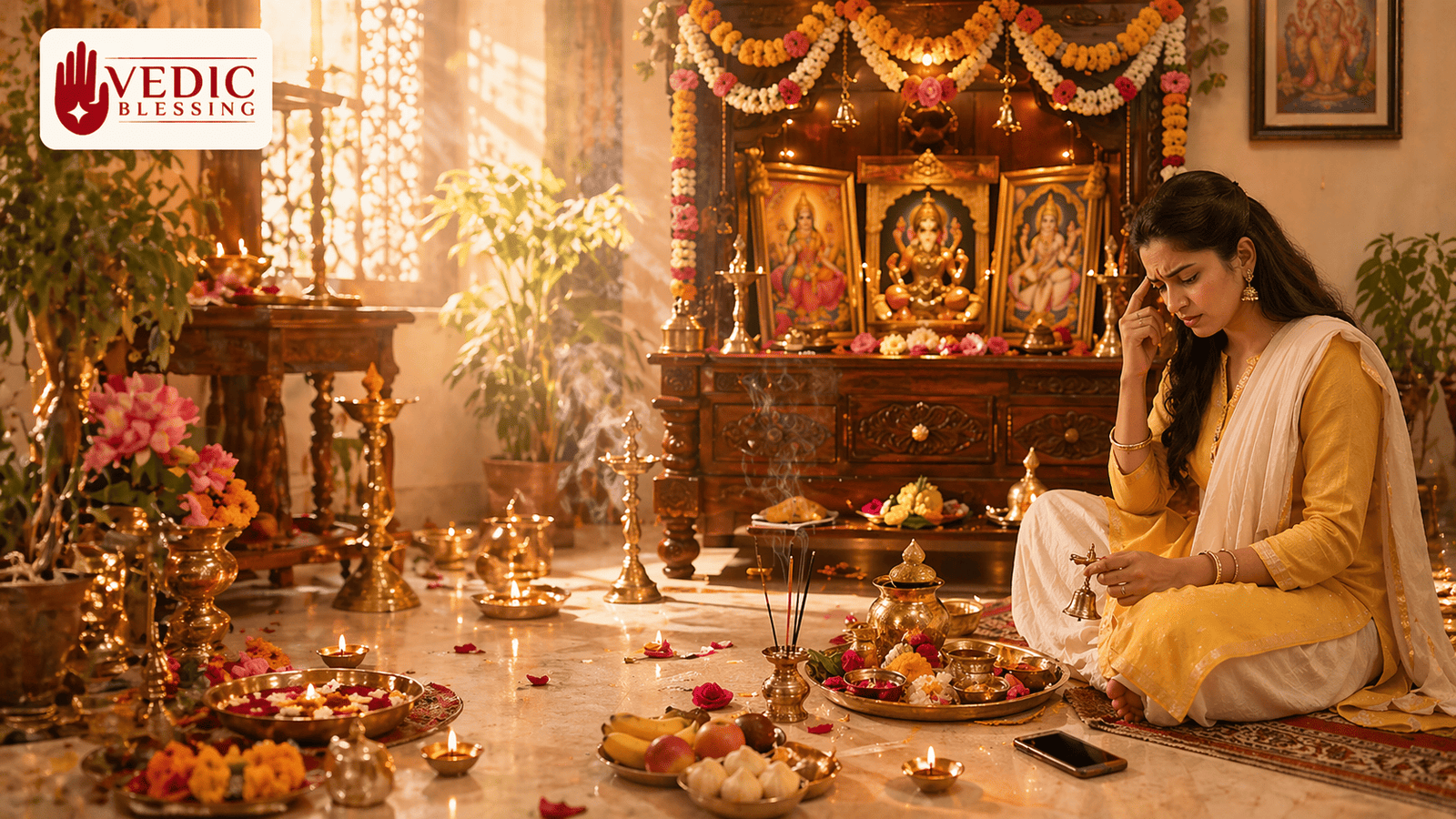
7 Common Mistakes Hindus Make While Performing Puja at Home
Every Hindu family performs puja at home with deep devotion. Lighting the diya, offering flowers, chanting prayers — these are sacred moments that connect us to the divine. But despite our sincerity, many of us unknowingly make small mistakes that reduce the spiritual benefits of our puja.
These aren't mistakes of the heart. Devotion is never wrong. They are mistakes of vidhi — the prescribed method that our shastras have preserved for thousands of years. When vidhi is followed correctly, the puja's phala (spiritual fruit) is complete. When important steps are missed, the blessings are reduced.
In this blog, we'll walk you through the 7 most common puja mistakes Hindus make at home, why each one matters, and how you can easily avoid them with proper guidance.
👉 Want to make sure your next puja is done correctly? Book an Online Pandit for Expert Guidance →
🕉️ Quick Overview: The 7 Mistakes at a Glance
- Performing puja without checking the right muhurtham
- Incorrect mantra pronunciation
- Skipping the sankalpam (intention-setting)
- Wrong direction for idol placement or seating
- Using incorrect or substituted samagri
- Performing puja in an impure space or state
- Missing or disordering key puja steps
Let's look at each one in detail — and understand how to do it right.
Mistake 1: Performing Puja Without Checking the Right Muhurtham
Why Muhurtham Matters in Every Puja
In Vedic tradition, time is not neutral. Every moment carries a specific cosmic energy shaped by the position of planets, nakshatras, and tithis. An auspicious muhurtham amplifies the puja's power. An inauspicious one weakens it — no matter how sincere your devotion.
Common Muhurtham Mistakes People Make
- Performing puja during Rahu Kalam or Yamagandam
- Choosing a day without checking the tithi and nakshatra
- Starting a homam during an inauspicious lagna
- Scheduling important samskaras without proper muhurtham calculation
- Ignoring personal nakshatra compatibility with the puja date
How to Fix This
Before any puja, always check the Panchang for that day. For important pujas, homams, or samskaras, consult an experienced pandit who can calculate the exact muhurtham based on your personal horoscope.
👉 Check today's auspicious timings with our Free Panchang Tool →
Mistake 2: Incorrect Mantra Pronunciation
Why Sanskrit Pronunciation Is Non-Negotiable
Sanskrit is not just a language — it is a vibrational science. Each syllable carries a specific sound frequency designed to invoke a particular divine energy. When mantras are mispronounced, the vibration changes, and the intended result is diminished.
Where People Commonly Go Wrong
- Reading mantras from English transliterations (which rarely capture the correct pronunciation)
- Confusing similar sounds like "sha" (श) and "sa" (स)
- Mispronouncing long and short vowels
- Skipping the correct swara (intonation) for Vedic mantras
- Chanting too fast without proper rhythm
How to Fix This
Learn mantras from a qualified source — a pandit, a Vedic teacher, or an authentic audio recording from a trained priest. For homams and dosha pujas especially, never attempt to chant complex mantras on your own without guidance. A pandit who has trained in Vedic gurukul tradition is trained specifically for this purpose.
Mistake 3: Skipping the Sankalpam (Intention-Setting)
What Is Sankalpam and Why Is It Critical?
Sankalpam is the formal declaration of intention at the beginning of every puja. It is the step where you consciously state:
- Who is performing the puja (your name, gotra, nakshatra)
- Where it is being performed (your location, date, tithi)
- Which deity is being worshipped
- What the purpose is (peace, prosperity, removal of obstacles, etc.)
Without sankalpam, the puja's purpose is unclear — and unclear intentions do not attract clear blessings.
Why People Skip It
- They don't know what sankalpam is
- They think devotion alone is enough
- They don't know their gotra, nakshatra, or proper declaration
- They rush into the puja directly
How to Fix This
Every puja — even a simple Ganesh Puja at home — should begin with sankalpam. If you don't know your gotra or nakshatra, a pandit can help you identify them during the booking. An experienced online pandit will always begin your puja with a proper sankalpam.
Mistake 4: Wrong Direction for Idol Placement or Seating
Why Direction Matters in Puja
Vedic Vastu Shastra prescribes specific directions for puja and idol placement because energy flows differently from each direction. When your altar is placed incorrectly, even the best puja loses some of its effectiveness.
Common Directional Mistakes
- Keeping the puja altar in the south (most inauspicious direction for worship)
- Facing south while performing puja (energetically draining)
- Placing the idol facing the wall instead of outward
- Setting up the altar near a toilet or kitchen wall
- Performing puja with your back to the main door
The Correct Approach
- Puja altar should be in the northeast (Ishanya) corner of the home
- Devotee should face east or north while performing puja
- Deity should face west or south (so it looks at the devotee facing east or north)
- The space should be clean, well-lit, and separate from bathrooms
Mistake 5: Using Incorrect or Substituted Samagri
Why Samagri Matters
Samagri is the sacred collection of items offered during puja — flowers, leaves, kumkum, turmeric, incense, fruits, and more. Each item has a specific purpose and a specific deity it is associated with.
Common Samagri Mistakes
- Offering tulsi leaves to Lord Ganesha (tulsi is not offered to Ganesha)
- Offering bilva leaves to deities other than Lord Shiva
- Using artificial flowers or plastic decorations
- Skipping essential items like akshata (rice), kumkum, or haldi
- Replacing traditional items with "whatever is available"
- Using expired or impure items (stale flowers, old ghee)
How to Fix This
Before any significant puja, get a proper samagri checklist from a qualified pandit. When you book an online pandit through Vedic Blessing, you receive a complete samagri list in advance so nothing is missed.
👉 Book an online pandit and receive a complete samagri checklist before your puja. Book Now →
Mistake 6: Performing Puja in an Impure Space or State
Why Shuddhi (Purity) Is Essential
Our shastras emphasize that puja must be performed in a state of internal and external purity. This isn't about being judgmental — it's about creating the right spiritual environment for divine energies to enter.
Common Purity Mistakes
- Performing puja without bathing first
- Wearing unwashed or inappropriate clothes
- Entering the puja room with footwear
- Performing puja in a cluttered or dirty space
- Women performing puja during menstruation (as per traditional shastras)
- Eating non-vegetarian food or consuming alcohol before puja
- Performing puja with a disturbed or angry mind
The Correct Approach
- Bathe and wear clean, traditional clothes before puja
- Keep the puja space clean and decluttered
- Mentally prepare with a few minutes of silence or meditation
- Avoid tamasic food (onion, garlic, non-veg) on the day of important pujas
- Maintain a calm, focused state of mind throughout
Mistake 7: Missing or Disordering Key Puja Steps
The Correct Sequence of a Traditional Puja
Every puja follows a prescribed sequence. When steps are skipped or performed in the wrong order, the energy flow is disrupted. The standard Vedic puja sequence is:
- Achamanam — purifying sips of water
- Sankalpam — stating the intention
- Ganesha Vandana — invoking Lord Ganesha to remove obstacles
- Avahanam — inviting the main deity
- Asana, Padya, Arghya — offering seat, water for feet, and hands
- Snanam — symbolic bathing of the deity
- Vastra, Yagnopaveetam — offering clothes and sacred thread
- Gandha, Pushpa, Dhupa, Deepa — sandal, flowers, incense, lamp
- Naivedyam — food offering
- Tambulam — offering betel leaves and nuts
- Aarti (Neerajanam) — final waving of lamps
- Pradakshinam and Namaskaram — circumambulation and salutations
- Mantra Pushpam — final mantras
- Udvasanam — respectful conclusion
Where People Commonly Go Wrong
- Performing aarti before naivedyam (should be reverse)
- Skipping Ganesha Vandana
- Forgetting udvasanam (proper conclusion of the puja)
- Rushing through the sequence without mantras
- Not offering naivedyam before eating
How to Fix This
For simple daily puja, a shortened version is acceptable. But for any festival puja, vratham, samskara, or homam, the full sequence must be followed. An experienced pandit ensures every step is done in the correct order.
Why These Mistakes Reduce Your Puja's Benefits
You might wonder — "If my devotion is pure, does it really matter if I make small mistakes?"
The honest answer from our shastras is: yes, it matters.
Devotion opens the door to the divine. But vidhi ensures the blessings flow through correctly. A puja is both an emotional and an energetic process. The mantras, the sequence, the timing, and the offerings all work together like a precise formula. Change one element, and the result changes too.
This doesn't mean your daily prayers are worthless. For daily nitya karma, devotion is enough. But for important pujas, homams, dosha nivaran, or samskaras, correctness and devotion must go hand in hand.
How Online Pandit Guidance Eliminates All 7 Mistakes
When you perform puja alone, it's easy to miss even one of these important elements. With online pandit guidance, every mistake is automatically prevented:
- Muhurtham — calculated for you in advance
- Mantras — chanted correctly by a trained pandit
- Sankalpam — performed with your personal details
- Direction and setup — guided before the puja begins
- Samagri — complete checklist provided in advance
- Purity protocols — explained before the puja day
- Sequence — led step-by-step by the pandit on video call
You stay in your own home, at your own altar, with your own family — but every ritual detail is handled by an expert. This is the best of both worlds: authentic Vedic correctness with modern convenience.
👉 Ready to perform your next puja without mistakes? Book an Online Pandit Today →
Who Should Book an Online Pandit for Their Next Puja?
- Families preparing for Griha Pravesh, Namakaranam, or Seemantham
- Anyone planning a homam or dosha nivaran puja
- NRI families celebrating festivals abroad
- First-time puja performers who want to do it right
- Parents wanting authentic samskaras for their children
- Busy professionals who can't find a qualified local pandit
How to Choose the Right Online Pandit
Not every online pandit service is the same. Look for:
- Vedic-trained pandits from traditional gurukul backgrounds
- Specialization in your specific puja
- Transparent pricing and samagri guidance
- Language options (Hindi, Telugu, Tamil, Sanskrit, English)
- Verified reviews and testimonials
At Vedic Blessing, every pandit in our network is personally verified for Vedic knowledge, ritual experience, and devotion. From a simple Ganapati Homam to a full Chandi Homam, every puja is handled with complete authenticity.
Final Thoughts — Devotion With Correct Vidhi Brings Complete Blessings
Performing puja at home is a beautiful expression of devotion. Don't let small, unknowing mistakes reduce the blessings you deserve.
By avoiding these 7 common puja mistakes — muhurtham, mantras, sankalpam, direction, samagri, purity, and sequence — you ensure your puja brings its full spiritual reward.
And when in doubt, don't hesitate to seek expert guidance. A qualified online pandit is just a call away, ready to ensure every puja is performed with complete authenticity and correct vidhi.
🙏 Book Your Online Pandit Today
Whether it's a simple Satyanarayan Vratham, a Griha Pravesh ceremony, or a powerful Navagraha Homam — Vedic Blessing connects you with experienced Vedic pandits who guide you through every step, ensuring no mistake reduces your puja's blessings.
→ Talk to Our Team on WhatsApp
📞 Call us at +91 9063082668 | ✉️ support@vedicblessing.com