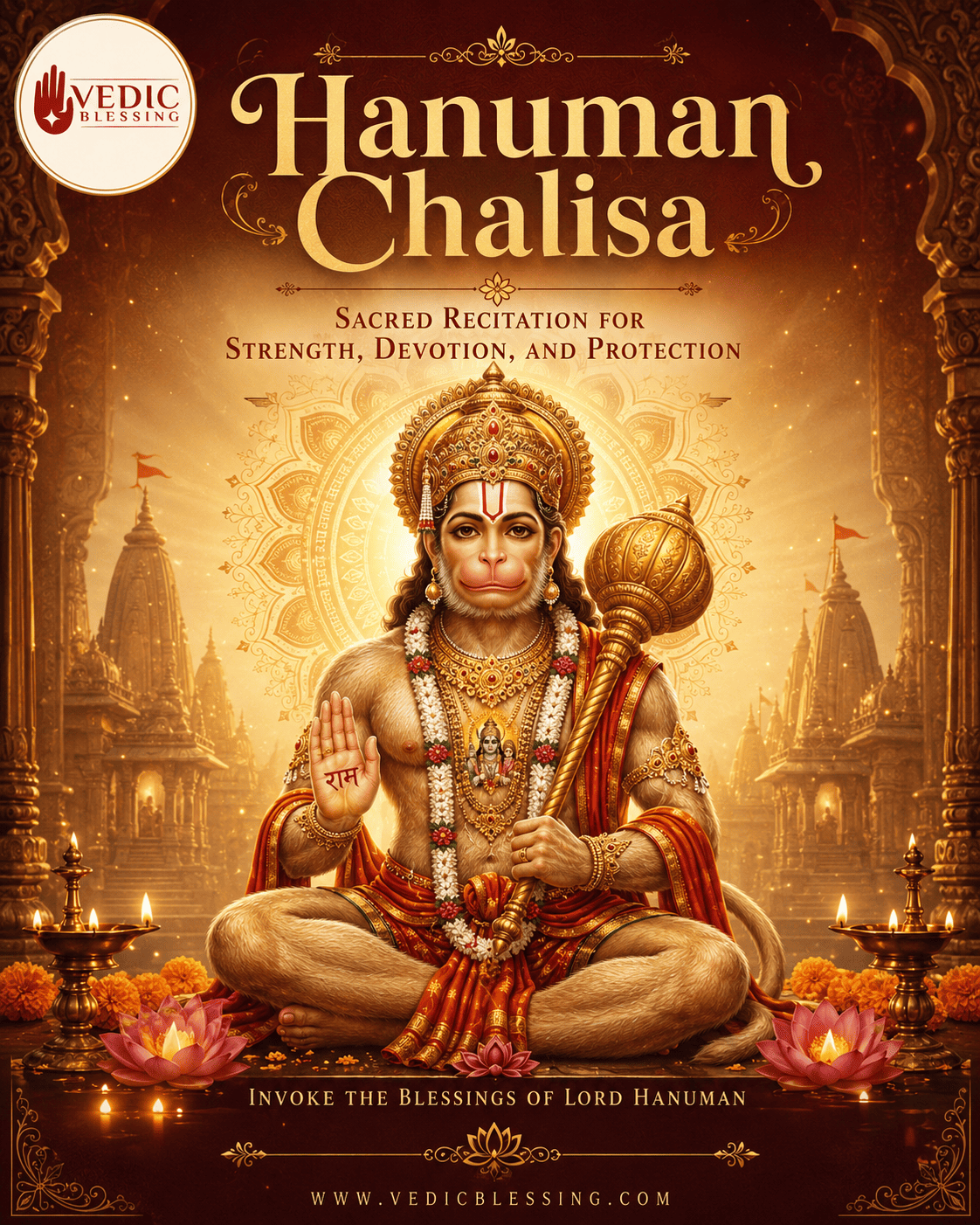
Hanuman Chalisa — Meaning, Power & Why It's the Soul of Hanuman Jayanthi
When Tulsidas penned the Hanuman Chalisa over 400 years ago in Awadhi, he didn't just write a hymn—he gifted humanity a 40-verse pocket of pure energy. Forty doha-chaupais that have since echoed in every Hindu home, temple, and heart across the world.
This Hanuman Jayanthi, May 12, 2026, as we celebrate Bajrangbali's birth, there is no greater offering than understanding the very prayer that carries his name across generations.
Let's go beyond the recitation into the meaning.
What is the Hanuman Chalisa?
Chalisa comes from "chalis," meaning “forty.” It's a devotional hymn of 40 verses written by Sant Tulsidas, the same saint who gave us the Ramcharitmanas. Composed in simple Awadhi (a dialect of Hindi), it was meant for the common devotee—not Sanskrit scholars.
That's its genius. Anyone can chant it. Everyone can feel it.
The Spiritual Architecture
The Chalisa opens with 2 dohas (couplets) — invocations Followed by 40 chaupais (quatrains) — the heart And closes with 1 doha — the seal
Total: 43 verses, but called "Chalisa" for the 40 core ones.
Key Verses & Their Deep Meaning
Opening Doha — The Surrender
"Shri Guru Charan Saroj Raj, Nij Manu Mukuru Sudhari..."
Meaning: Cleansing the mirror of my mind with the dust of my Guru's lotus feet, I narrate the pure glory of Sri Ram.
Depth: Before invoking Hanuman, Tulsidas bows to the Guru. The lesson — no spiritual journey begins without humility.
Verse 1 — The Identity
"Jai Hanuman gyan gun sagar, Jai Kapis tihu lok ujagar"
Meaning: Victory to Hanuman, ocean of wisdom and virtue. Victory to the Lord of monkeys, illuminator of all three worlds.
Depth: Hanuman isn't just strength. He is gyan (wisdom) + gun (virtue) — the rare combination of power guided by character.
Verse 7 — The Form
"Kanchan baran biraj subesa, Kanan kundal kunchit kesa"
Meaning: Golden-hued, beautifully adorned, with earrings and curly hair.
Depth: Hanuman is described not as fierce, but as radiant and graceful — reminding us that true power is luminous, never harsh.
Verse 11 — The Devotion
"Prabhu mudrika meli mukh mahi, Jaladhi langhi gaye acharaj nahi"
Meaning: Carrying Lord Ram's ring in his mouth, he leapt across the ocean — no wonder at all.
Depth: When the heart carries the Lord's name, no ocean is too wide. This is the verse of impossible tasks made possible.
Verse 25 — The Protection
"Bhoot pisach nikat nahi aave, Mahabir jab naam sunave"
Meaning: Ghosts and evil spirits dare not come near when the name of Mahavir (Hanuman) is uttered.
Depth: This is why the Chalisa is chanted at night, in fear, in illness. His name itself is the shield.
💫 Looking to bring that protective energy into your home? A Sudarshana Homam or Navagraha Shanti Puja performed live by our certified pandits clears negativity and strengthens your home's spiritual shield. Explore Homam services →
Verse 31 — The Boon-Giver
"Charo jug partap tumhara, Hai parsiddh jagat ujiyara"
Meaning: Your glory shines through all four ages — known and worshipped throughout the world.
Depth: Hanuman is the chiranjeevi — the immortal one. He is still present wherever Ram's name is sung. Not myth. Living presence.
Verse 36 — The Promise
"Jo sat baar paath kar koi, Chhutahi bandi maha sukh hoi"
Meaning: Whoever recites this 100 times is freed from all bondage and attains supreme bliss.
Depth: The Chalisa is not just prayer—it's a mantra-yantra. Repetition is the key that unlocks its frequency.
Should You Chant Only These Verses?
A common question is—"If these verses are so powerful, can I just chant these?"
The answer is gentle but clear: No. The Hanuman Chalisa is one complete prayer, not a menu to pick from. You chant it fully, from start to finish — that's how Tulsidas composed it, and that's how it has been chanted for 400 years.
Why the whole matters:
🪔 It's a complete spiritual journey — the opening dohas invite the Guru and Hanuman, the 40 chaupais reveal his glory and powers, and the closing doha seals the prayer with surrender. Stopping in between is like lighting a lamp halfway.
🕉️ The vibration builds with the whole — each verse adds spiritual energy, creating a complete frequency. That's why benefits are always tied to "ek paath" (one full reading), "sat baar" (100 times), or "sahasra paath" (1,000 times) — never partial.
📖 Tulsidas himself promises in Verse 36 — "Whoever recites this 100 times..." — and "this" means the entire Chalisa, not selected verses.
So what are these explained verses for?
For understanding, not separate worship.
| Purpose | Practice |
|---|---|
| Daily worship / Jayanthi | Chant the full Chalisa |
| Understanding what you chant | Read these key verses' meanings |
| In moments of fear | Chant the full Chalisa, with heart on Verse 25 (protection) |
| Before a big task | Chant the full Chalisa, meditating on Verse 11 (impossible made possible) |
The meaning of these verses deepens your full chanting—they don't replace it.
✨ Simple rule: For worship → chant the full Hanuman Chalisa. For understanding → study the meaning of key verses. For comfort → repeat a favorite verse anytime, alongside your daily full paath.
Why Chant the Hanuman Chalisa?
🛡️ Protection — From fear, negativity, evil influences 💪 Strength — Mental, physical, and spiritual courage 🧘 Focus — Calms a restless mind and sharpens intent 🪔 Devotion — Deepens bhakti and surrender to Ram 🌙 Sleep & Peace—Chanted at night for restful protection 🚪 Removes Obstacles — Sankat Mochan (remover of distress)
How to Chant — The Right Way
- Bath & clean clothes — purity of body precedes purity of mind
- Face East or North—sit in front of Hanuman's image or sindoor lamp
- Light a lamp with til (sesame) oil—Hanuman's beloved offering
- Chant with bhav (feeling) — not speed
- Tuesdays & Saturdays — Hanuman's sacred days
- 108 times = full cycle—11 times daily for 41 days = transformation
🪔 Want to deepen your spiritual practice beyond the Chalisa? From Satyanarayana Vratham and Rudrabhishekam to Pitru Tarpanam and Ganesh Homam, VedicBlessing brings authentic Vedic ceremonies to your home — wherever you are. Browse all pujas
Hanuman Chalisa on Hanuman Jayanthi 2026
This May 12, 2026 — the day Anjaneya Swamy descended to earth — chanting the Chalisa is the most direct way to receive his blessings.
Many Telugu families complete the 41-day Hanuman Deeksha by reciting the Chalisa 11, 21, or 108 times on Jayanthi day, accompanied by:
- Sindoor application on the idol
- Boondi laddoo or vada offering
- Sundara Kanda parayanam
- Ghee or til oil deepam
If distance, time, or circumstance keeps you away from a temple—your home, your voice, your Chalisa is enough. Hanuman dwells where his name is sung.
A Final Reflection
The Hanuman Chalisa is not 40 verses about a deity. It is 40 verses about what we can become — fearless, faithful, humble, strong, and forever surrendered to a higher purpose.
This Hanuman Jayanthi, don't just chant the Chalisa. Listen to it. Feel it. Live it.
Jai Bajrangbali. Jai Hanuman. Jai Shri Ram. 🚩
Bring authentic Vedic pujas home — every season, every reason. From Satyanarayana Vratham to Rudrabhishekam, Pitru Tarpanam to Ganesh Homam, VedicBlessing connects NRI families with certified South Indian pandits live online. Your home, your time, your tradition — done the right way. Browse all services →