🌸 Shakti Peethas
Vaishno Devi Temple
वैष्णो देवी मंदिर
About the Deity
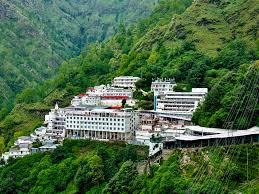
Vaishno Devi, enshrined in the sacred caves of Trikuta Hills in Jammu, represents one of the most widely worshipped manifestations of the Divine Mother, revered as Vaishnavi and associated with the dynamic, protective, and preserving principle of Shakti. The exact body part commemorated at this Shakti Peetha is debated—some traditions hold that the upper teeth of Sati fell here, while others claim it was the entire body or specific vital organs—reflecting the profound mystery that surrounds this sacred site. Vaishno Devi is depicted in classical iconography as a compassionate yet powerful goddess, sometimes shown as a unified trinity (Mata, Saraswati, Lakshmi) representing the three primary functions of Shakti in cosmic operation. She is most commonly portrayed in her benevolent motherly aspect, adorned with jewels and garlands, radiating warmth and protection to all devotees. The goddess is predominantly worshipped through the sacred stones found within the temple caves—the Pindis—which represent her manifest form, yet she transcends physical representation and is understood as omnipresent consciousness that interpenetrates all existence. Vaishno Devi is unique in Hindu pilgrimage practice because reaching her sanctuary requires a demanding physical journey through mountain terrain, establishing the pilgrimage itself as part of spiritual practice. The goddess is believed to test the devotion and sincerity of pilgrims through the difficulty of the path, ensuring that only those with genuine faith and commitment reach her inner sanctum. She embodies the principle of grace that meets sincere effort, the mother who rewards her children's determination with blessings, and the protector who guards the sacred space from those without pure intention. The sanctuary itself, hidden within natural mountain caves, represents the innermost chamber of the divine heart—the secret place where the goddess dwells in direct communion with her most devoted children.
Mythology & Legend
The Vaishno Devi mythology is woven into the great cosmic narrative of Sati's sacrifice but includes unique local legends that have enriched the tradition over centuries. When Sati's body was dispersed across the sacred landscape following her immolation, her divine energy coalesced at various locations, and in the Trikuta Hills, the goddess manifested in her form as Vaishnavi—the power of Vishnu, the preserver, the protector who maintains cosmic order and safeguards her devotees. The sacred geography of Trikuta Hills is itself part of the mythology; local tradition describes how the three peaks represent the trinity of divine power, and how the goddess chose this remote, challenging location as her meditation seat precisely because it would serve as a test of sincere devotion. According to the Markandeya Purana and various regional texts specific to the Vaishno Devi tradition, the goddess appeared in visions to the sage Giriraj, instructing him in the proper rituals and protocols for her worship. Giriraj is credited with establishing the formal temple structure and the systematic approach to goddess worship at this site, creating a continuous lineage of priestly service that persists to this day. Local legends describe how Vaishno Devi continuously manifests as a protective presence in the region, intervening in the lives of devotees in times of danger and distress. Stories abound of how the goddess has appeared in human or divine form to guide lost pilgrims, protect them from physical danger, and reveal herself to seekers with pure hearts. The mythology emphasizes that Vaishno Devi is not merely a goddess of one location but a living presence that exists in the hearts of all devotees, manifesting as the inner guide and protecting mother. The challenging pilgrimage route through mountain terrain is interpreted as an enactment of the spiritual path itself—the ascent toward the divine required overcoming physical obstacles, mental doubts, and karmic impediments. Every rock, every stream, every cave along the pilgrimage route is understood as the goddess's extended body, and the journey itself becomes a form of direct communion with divine consciousness.
Kshetra Mahatmya — Significance
Vaishno Devi temple represents one of the most significant pilgrimage sites in Hindu sacred geography, documented extensively in the Markandeya Purana, the Devi Bhagavata Purana, the Brahma Vaivarta Purana, and numerous regional texts that emphasize its supreme importance as a Shakti Peetha of extraordinary power. The Trikuta Hills themselves hold immense spiritual significance—the three peaks are understood to represent the trinity of divine manifestation and the three gunas that compose all material existence. The geographical location in Jammu, in the northernmost sacred landscape of India near Kashmir, places Vaishno Devi at the intersection of multiple pilgrimage routes and energy meridians that converge across the subcontinent. The temple's documented history extends back centuries, with historical records indicating continuous worship and the gradual development of the pilgrimage infrastructure that has evolved into one of the world's most visited temples. The Markandeya Purana specifically describes Vaishno Devi as a paramount center of Shakti worship where the goddess grants direct darshan to sincere devotees and fulfills wishes that cannot be fulfilled elsewhere. The natural cave sanctuary within which the temple is located is itself a place of profound spiritual power—the caves represent the innermost chamber of the cosmic womb, the secret sanctuary where the goddess dwells in eternal meditation. The annual pilgrimage season brings millions of devotees from across India and worldwide to undertake the demanding journey to her shrine, establishing Vaishno Devi as one of the world's most frequented sacred sites. The temple administration has maintained meticulous records of pilgrims for over a century, documenting the continuous flow of human devotion and the countless miraculous interventions reported by pilgrims. The presiding priests maintain unbroken lineages of worship and ritual knowledge specific to Vaishno Devi, preserving the authentic practices and mantras that connect modern devotees to the goddess's direct power. The temple's spiritual influence extends worldwide, with devotees from all corners of the globe acknowledging Vaishno Devi's supremacy and seeking her blessings through various means of connection and worship.
Blessings & Benefits
- Fulfills the sincere and righteous wishes of all pilgrims who undertake the sacred trek.
- Blesses devotees with robust health, prosperity, and protection for themselves and their families.
- Granted as especially powerful for those seeking a fresh start and renewed life direction.
- The pilgrimage journey itself purifies the heart and strengthens one's faith and determination.
- Blesses devoted pilgrims with the mother's grace — unconditional love, protection, and lasting peace.
Temple Location
33.0279, 74.9503
Visitor Information
🕐 Timings
Open 24 hours
👗 Dress Code
Warm clothes essential. Traditional attire inside sanctum.
🪔 Prasad
Prasad with dry fruits and mishri
🎟 Entry
Free. Helicopter service: Rs. 1200 one way.
🅿️ Parking
Available at Katra
♿ Access
Pony, palki, and helicopter services available for mobility-impaired
Best Time to Visit
📅 Best Day
Daily (All days auspicious), Navratri, Ashtami
🗓 Months
Navratri (March-April and September-October)
🌤 Season
Summer (May-June) and Navratri periods
How to Reach
🚂 Railway
Katra Station (0.5 km)
✈️ Airport
Jammu Airport (50 km)
📮 Address
Trikuta Hills, Katra, Reasi District, Jammu & Kashmir 182301
Major Festivals
🎉 Navratri (twice a year)
🎉 Durgashtami
🎉 Bhaironji Yatra