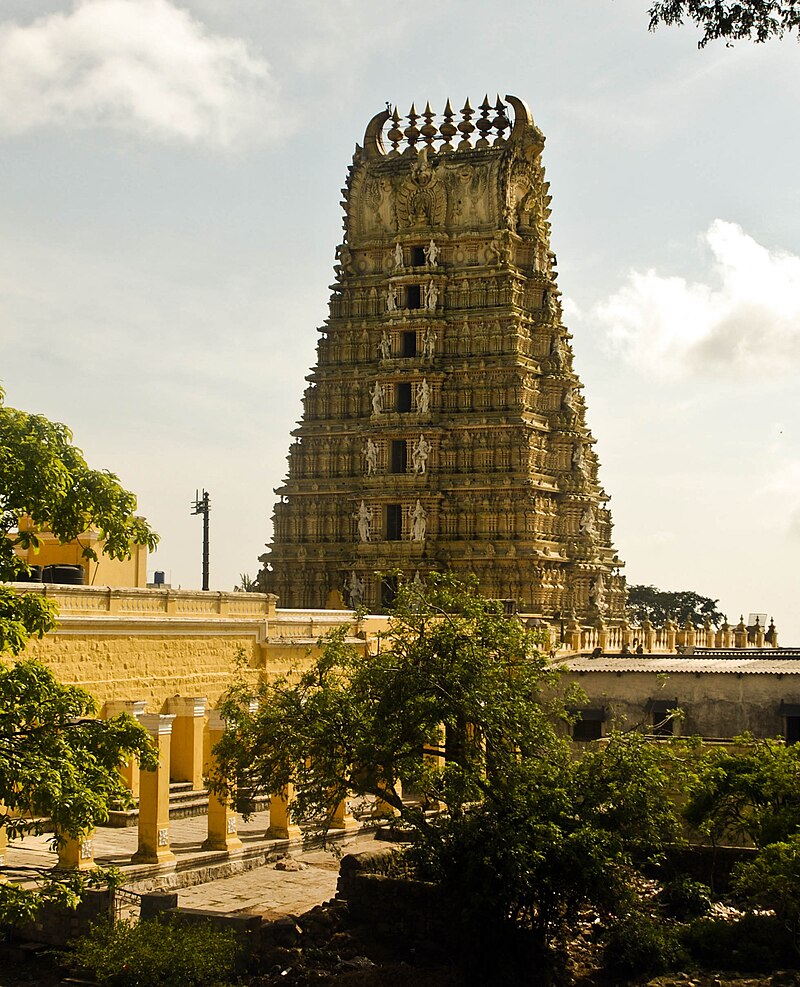
🌸 Shakti Peethas
Chamundeshwari Temple
ಚಾಮುಂಡೇಶ್ವರಿ ದೇವಸ್ಥಾನ
About the Deity
Chamundeshwari, the divine goddess enshrined on Chamundi Hills in Mysuru, Karnataka, represents one of the fiercest and most dramatically powerful manifestations of Shakti, embodying the principle of destruction of all that limits and binds consciousness. The hair of Sati fell at this sacred location, establishing Chamundeshwari as a center of the goddess's supreme power to transform and liberate through cosmic action. The goddess is depicted in classical iconography as riding upon a lion or tiger, wielding weapons of power—the sword, bow, and arrow—in her multiple hands, with her dark-complexioned form radiating an almost palpable intensity of divine energy. Her hair, often shown unbound and flowing wildly in cosmic wind, represents the untamed and unconditioned power of Shakti liberated from all limitation and restriction. Chamundeshwari is specifically known as the slayer of demons, particularly the buffalo demon Mahishasura and the twin demons Chunda and Munda, whose destruction is celebrated in the Devi Mahatmya as one of the greatest cosmic victories of divine power. Yet beyond her fierce warrior aspect, Chamundeshwari represents the deep compassion of the mother who destroys only that which must be destroyed for the liberation and evolution of her children. She is worshipped as the protector of Mysuru and its surroundings, her presence extending comprehensive spiritual protection and blessings to all residents and devotees. The goddess's hair, specifically commemorated at this site, represents the goddess's power of extension and manifestation—how the divine mother reaches out and touches every corner of creation, how she enters into direct relationship with all beings through infinite forms and expressions.
Mythology & Legend
The Chamundeshwari mythology is intricately connected to the great Devi Mahatmya narrative, which describes the cosmic battles through which the Divine Mother defeats all forces of destruction and ignorance. While Chamundeshwari is fundamentally an aspect of Sati, her mythology is enriched through the stories of the demons she defeats—Mahishasura, Chunda, and Munda—whose destruction represents the goddess's triumph over all that obscures truth and creates suffering. According to the Markandeya Purana and the Devi Bhagavata, when Sati's body was dispersed following the cosmic event at Daksha's yagna, at the location of present-day Chamundi Hills, her hair fell to earth and transformed into the powerful goddess Chamundeshwari. The local mythology of Mysuru describes how the goddess appeared to the founding kings and offered her protection and blessings to the kingdom, establishing a covenant wherein the monarch served as the goddess's earthly representative. The Chamundi Hills themselves are understood as the goddess's sacred body—each stone, each tree, each water source representing some aspect of her divine form. Local legends describe how the goddess has appeared in visions and dreams to her most devoted children, offering guidance, protection, and direct blessings. The mythology emphasizes that Chamundeshwari is not merely a goddess of ancient times but a living presence continuously engaged in protecting her devotees from all forms of danger and darkness. Stories abound of how the goddess has intervened in wars and conflicts, how she has protected the innocent from tyranny, and how she continues to manifest her power in the lives of sincere devotees. The epic battles described in the Devi Mahatmya are interpreted not only as historical cosmic events but as eternal principles—the eternal conflict between light and darkness, wisdom and ignorance, liberation and bondage, fought perpetually within the consciousness of every human being.
Kshetra Mahatmya — Significance
Chamundeshwari temple holds an exalted position in Hindu sacred geography as documented in the Markandeya Purana, the Devi Bhagavata Purana, and the Shakti Peetha traditions, identified as one of the 51 supreme centers of Shakti worship. The Chamundi Hills themselves are geographical and spiritual phenomena of extraordinary significance—the site of ancient temples dating back over a thousand years, with historical records indicating continuous royal patronage and the gradual development of one of South India's most important temples. The temple's location overlooking Mysuru city established it as a symbol of divine protection over the kingdom and its inhabitants. The Markandeya Purana specifically describes Chamundeshwari as a paramount Shakti Peetha where the goddess grants direct darshan and fulfills the wishes of sincere devotees. Historical records document the temple's development during various periods—the medieval period saw construction of the central sanctum and major portions of the current architectural structure, while the 19th and 20th centuries witnessed further expansion and renovation. The 1000 Pillar Temple inscriptions on Chamundi Hills provide epigraphic evidence of the continuous worship and significance of this site. The geographical prominence of the Chamundi Hills, combined with the temple's position overlooking the sacred city of Mysuru, creates a unique spiritual atmosphere where the goddess's protective power is immediately palpable. The annual Dussehra festival celebrations at Chamundeshwari temple are among the most significant and well-attended in all of South India, commemorating the goddess's victory over all forms of ignorance and demonic forces. The temple administration has maintained meticulous records of pilgrimage and worship practices, preserving the authentic rituals and mantras specific to Chamundeshwari worship. The presiding priests represent lineages of spiritual authority and ritual expertise spanning centuries, maintaining the temple as an active center of living Hindu spirituality. The temple's architecture—featuring the distinctive South Indian gopuram style combined with unique local elements—represents the synthesis of northern and southern Hindu traditions at this sacred site.
Blessings & Benefits
- Grants victory, courage, and protection from all enemies and life challenges.
- Blesses devotees with good health, long life, and freedom from chronic ailments.
- The Dasara celebrations here amplify blessings for all who attend and participate.
- Granted as especially powerful for those in positions of leadership and responsibility.
- Blesses sincere pilgrims with the fierce grace of Chamundeshwari — strength, fearlessness, and liberation.
Temple Location
12.2726, 76.6656
Visitor Information
🕐 Timings
7:30 AM - 2:00 PM, 3:30 PM - 6:00 PM, 7:30 PM - 9:00 PM
👗 Dress Code
Traditional Indian attire
🪔 Prasad
Laddu prasadam
🎟 Entry
Free. Special darshan: Rs. 50-100
🅿️ Parking
Available
♿ Access
Accessible by road. Steps are steep.
Best Time to Visit
📅 Best Day
Tuesday, Friday, Navratri, Ashtami
🗓 Months
Navratri/Dasara (September-October)
🌤 Season
All seasons
How to Reach
🚂 Railway
Mysuru Station (13 km)
✈️ Airport
Mysuru Airport (12 km) / Kempegowda International Airport, Bengaluru (170 km)
📮 Address
Chamundi Hills, Mysuru, Karnataka 570010
Major Festivals
🎉 Navratri/Dasara (royal celebrations)
🎉 Navaratri
🎉 Karthika Deepotsava