🔱 Jyotirlingas
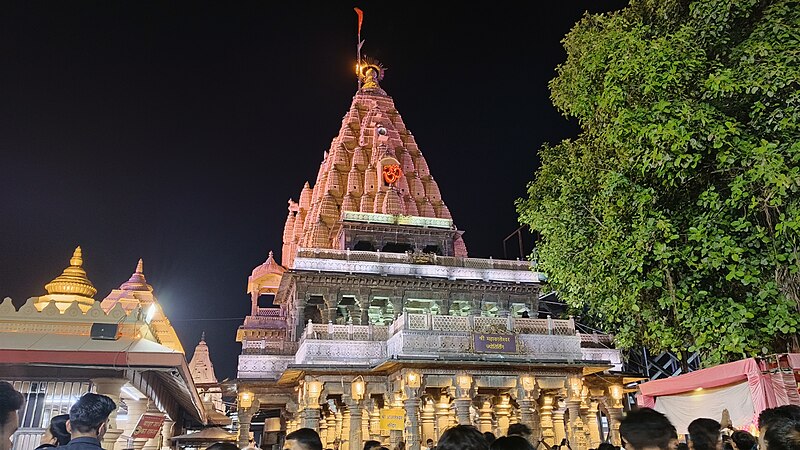
Mahakaleshwar Temple
महाकालेश्वर मंदिर
About the Deity
The Mahakaleshwar Linga at Ujjain is uniquely revered as a Dakshinamukhi Shivalinga, meaning the linga faces the southern direction—an exceptionally rare orientation in Hindu shrine architecture. This southward-facing aspect makes Mahakaleshwar extraordinarily potent for practitioners of Tantra and those seeking to directly access the transcendent form of Shiva that governs time, dissolution, and the ultimate transformation of consciousness beyond form and manifestation. The linga itself is believed to be a naturally formed stone that emerged from the earth at the precise location of the temple, possessing an ancient patina and sacred lustre that reflect millennia of worship and devotional energies. The presiding deity is invoked as Mahakala, literally "Great Time" or "Death," reflecting Shiva's sovereignty over all temporal cycles and his role as the ultimate destroyer of illusion and limitation. The sanctum sanctorum maintains an extraordinarily cool temperature year-round, a phenomenon that devotees attribute to the linga's inherent cosmic power and its capacity to embody the infinite consciousness beyond the normal parameters of physical manifestation. The most distinctive ritual associated with Mahakaleshwar is the Bhasma Aarti, a sacred ceremony performed daily where sacred ash is applied to the linga and distributed to devotees as a blessing carrying profound spiritual potency. This ritual uniquely emphasizes Shiva's dominion over death and his grace in transforming human consciousness beyond the fear of mortality. The linga's appearance is distinctive, with natural striations and crystalline formations that make each viewing a unique revelation of divine geometry.
Mythology & Legend
The origin of the Mahakaleshwar Linga is recorded in the Skanda Purana and Ujjain Mahatmya with remarkable detail, recounting the story of a devoted child named Chandrasena whose unwavering faith moved Shiva himself to manifest in an unprecedented form. In ancient times, Ujjain was plagued by a terrifying demon named Dushasana who possessed extraordinary powers granted by a Brahmanical boon. The demon had become invincible through his tapasya and used his powers to torment the righteous and obstruct dharmic practices throughout the kingdom. The celestial beings and gods themselves were unable to subdue him, and the sacred land of Ujjain faced complete devastation. In this dark period, a young boy named Chandrasena, despite his tender age and limited capabilities, resolved to undertake a profound penance to invoke Shiva and request his intervention. The child journeyed to the banks of the Kshipra River and began an extraordinary spiritual practice, performing ablutions and meditating upon Shiva with unwavering focus, despite facing threats and obstacles placed by the demon to dissuade him. His pure intention, combined with his youthful innocence and devotional intensity, created a powerful resonance that pierced through the veils of cosmic manifestation. Shiva, eternally responsive to sincere devotion, appeared before the boy and manifested himself as the Mahakaleshwar Linga at the spot where the child's spiritual fires burned brightest. The appearance of this terrifying yet infinitely compassionate form of Shiva caused the demon Dushasana to be immediately obliterated by the deity's transcendent power. The linga subsequently became established as the supreme center of Shiva worship in Ujjain, representing the triumph of innocent faith over demonic forces and the eternal responsiveness of the divine to sincere spiritual aspiration. The Bhasma Aarti performed daily at Mahakaleshwar commemorates this cosmic victory and the continuous presence of Shiva's protective and redemptive power.
Kshetra Mahatmya — Significance
Ujjain holds an ancient and exalted position in Hindu cosmology and spirituality, being one of the four sacred cities where the Kumbha Mela—the most significant pilgrimage gathering in Hinduism—occurs once every twelve years. The city is glorified extensively in the Skanda Purana, Brahma Purana, and various Tantra texts as one of the greatest spiritual power centers on earth, a Mokshanagari where liberation from the cycle of birth and death is readily attainable for sincere seekers. The Mahakaleshwar temple stands as the central shrine of Ujjain's spiritual significance, and the presence of this Jyotirlinga transforms the entire region into a concentrated field of Shiva's cosmic consciousness. The city itself is positioned on the Kshipra River, one of the seven sacred rivers of India, and the river's waters are believed to directly carry the blessings of Mahakaleshwar to all who bathe within its flow. Historical records indicate that Ujjain was a major center of Hindu learning, astronomy, and spiritual philosophy, with numerous sages and philosophers maintaining hermitages in the surrounding forests and ghats. The Mahakaleshwar temple has been continuously worshipped for over two thousand years, with archaeological evidence and textual references supporting its ancient origins. The shrine has survived numerous invasions and periods of religious suppression, yet it remained a beacon of spiritual light and devotional fervor. The Bhasma Aarti ritual, performed twice daily, is considered one of the most potent spiritual ceremonies in all of Hindu practice, drawing thousands of devotees who arrive before dawn to participate in this transformation of consciousness. The temple's architecture reflects Malwa regional Shikara style, with intricate carvings and multiple subsidiary shrines dedicated to various aspects of Shiva and associated deities. The presence of the Sankat Mochan Temple, dedicated to Hanuman, within Ujjain's sacred geography creates an extraordinarily powerful resonance for those seeking both Shiva's transcendent wisdom and Hanuman's devoted service to higher principles.
Blessings & Benefits
- Frees devotees from Shani (Saturn) afflictions and all Navagraha-related troubles.
- Removes negative energies, evil eye, and deep-rooted fears from one's life.
- Blesses seekers with courage, clarity, and renewed life purpose.
- The Bhasma Aarti darshan grants extraordinary spiritual purification and upliftment.
- Bestows liberation and the grace of Mahakal on those who worship with devotion.
Temple Location
23.1828, 75.7682
Visitor Information
🕐 Timings
3:00 AM - 11:00 PM (Bhasma Aarti 4:00 AM - 6:00 AM)
👗 Dress Code
Traditional Indian attire. Dhoti mandatory for inner sanctum for men.
🪔 Prasad
Bhasma (sacred ash), Prasad Laddu
🎟 Entry
Free. Bhasma Aarti booking: Available online (Rs. 200-500)
🅿️ Parking
Available near temple
♿ Access
Limited wheelchair access
Best Time to Visit
📅 Best Day
Monday, Maha Shivaratri, Ekadashi
🗓 Months
Shravan (July-August), Kartik, Simhastha Kumbh Mela
🌤 Season
All seasons
How to Reach
🚂 Railway
Ujjain Junction (1 km)
✈️ Airport
Devi Ahilya Bai Holkar Airport, Indore (55 km)
📮 Address
Jaisinghpura, Ujjain, Madhya Pradesh 456006
Major Festivals
🎉 Bhasma Aarti daily
🎉 Maha Shivaratri
🎉 Simhastha Kumbh Mela (every 12 years)
🎉 Shravan Mahotsav