🔱 Jyotirlingas
Omkareshwar Temple
ओंकारेश्वर मंदिर
About the Deity
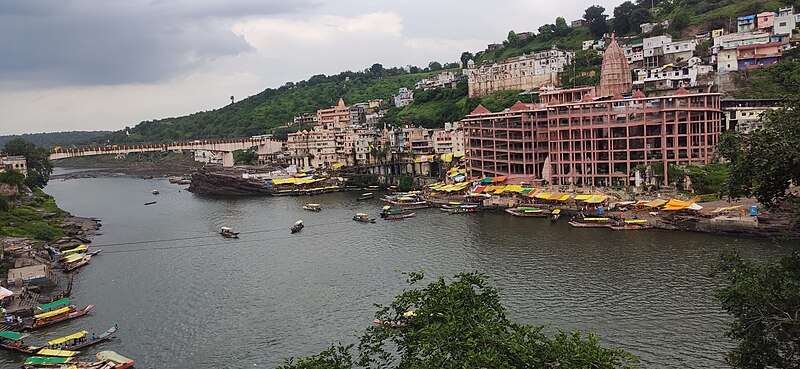
The Omkareshwar Linga at Mandhata Island represents Shiva's manifestation as the cosmic sound principle of Om, the primordial vibration from which all creation emerges and into which all creation ultimately dissolves. The term "Omkareshwar" derives from Om, the sacred syllable representing ultimate reality, and Ishwar, the Lord or supreme consciousness, signifying that this particular form of Shiva embodies the transcendent principle that underlies and pervades all existence. The sacred island itself is naturally shaped like the symbol Om, creating a unique circumstance where the geographical formation of the kshetra mirrors the cosmic principle embodied in the deity, creating extraordinary resonance and concordance between the physical location and the metaphysical principles it represents. The linga at Omkareshwar is believed to be one of the oldest continuously worshipped Shivalingas in all of India, with evidence of ritualistic practice dating back over three thousand years. The presiding deity is uniquely worshipped with specific rituals that emphasize the relationship between sound, consciousness, and creation, making this shrine particularly significant for practitioners of Mantra Shastra and those seeking to align their consciousness with the cosmic frequencies underlying manifestation. The sanctum sanctorum is positioned such that specific acoustic properties cause chanting and mantras performed within to resonate with extraordinary amplification and clarity, as if the linga itself amplifies and sanctifies all sacred utterances offered before it.
Mythology & Legend
The Omkareshwar Linga originates from one of the most profound narratives in the Skanda Purana concerning the cosmic competition between two celestial beings seeking supremacy and spiritual authority. According to these sacred narratives, in ancient times the devas and certain celestial entities engaged in debates concerning which cosmic principle was supreme—was it the principle of manifestation and creation, the principle of maintenance and order, or the principle of transcendent consciousness that underlies all being? To resolve this metaphysical dispute, Brahma and Vishnu agreed to undergo severe penances to determine which principle would ultimately be recognized as supreme. Brahma performed his tapasya at the sacred location that would become Pushkar, while Vishnu undertook his practices at what is now Badrinath. However, news reached Brahma and Vishnu that Lord Shiva himself had begun performing an even more extraordinary penance on the island of Mandhata in the Narmada River, a penance so intense and sacred that it began to destabilize the very fabric of cosmic reality. Shiva's meditation became so profound that the cosmic sound principle of Om began to emanate directly from his being, transforming the island into a vortex of transcendent consciousness and divine potency. The manifestation of the Omkareshwar Linga resulted directly from this cosmic penance, with the linga representing the crystallization of Om itself into physical form. Brahma and Vishnu recognized that Shiva had transcended their competition entirely by moving to a higher level of cosmic consciousness, and they humbly acknowledged Shiva's supreme position. The linga at Omkareshwar thus became established as a representation of the ultimate principle underlying all manifestation, the sacred sound from which all creation flows and to which all creation returns.
Kshetra Mahatmya — Significance
Omkareshwar stands as one of the most geographically and spiritually significant pilgrimage centers in all of central India, located on the sacred island of Mandhata in the Narmada River, which is itself glorified throughout Hindu scriptures as one of the most spiritually potent rivers of the Indian subcontinent. The Skanda Purana, Brahma Purana, and various Tantra texts extensively celebrate Omkareshwar as a supreme kshetra for all spiritual practitioners, from beginners to advanced adepts seeking final liberation. The natural Om-shaped configuration of the island itself creates an extraordinary energy vortex that amplifies spiritual practices performed within the kshetra, making meditation, mantra recitation, and ritual worship extraordinarily effective in this location. The Narmada River, flowing around the sacred island, is described in the Puranas as a goddess herself—Narmada Devi—whose waters possess direct purificatory and transformative properties. Pilgrims who bathe in the Narmada at Omkareshwar experience spiritual elevation and the washing away of karmic obstacles with unusual efficacy. The temple itself represents continuous religious architecture and renovation spanning over two thousand years, with evidence of patronage from multiple Hindu dynasties and kingdoms. The presiding deity is served by hereditary priesthoods that have maintained uninterrupted ritualistic traditions across countless generations, preserving sacred knowledge and esoteric practices that date back millennia. The sanctuary complex includes multiple subsidiary shrines dedicated to various aspects of Shiva, and the overall architectural design reflects sophisticated understanding of sacred geometry and cosmic principles. The presence of natural caves and meditation chambers in the surrounding area has served countless yogis, monks, and spiritual practitioners over the centuries seeking direct experience of the transcendent consciousness represented by Omkareshwar. The Kartik month pilgrimage, particularly at new moon times, is considered exceptionally auspicious for visiting Omkareshwar and undertaking intensive spiritual practices.
Blessings & Benefits
- Fulfills all material and spiritual desires of devotees who worship sincerely.
- Relieves Kaal Sarp Dosha, Pitru Dosha, and other astrological afflictions.
- Grants students and scholars clarity of mind and enhanced wisdom.
- A circumambulation of Mandhata Island brings merit equal to all sacred river pilgrimages.
- Blesses devoted pilgrims with liberation and the supreme grace of Omkareshwar.
Temple Location
22.2439, 76.1476
Visitor Information
🕐 Timings
5:00 AM - 10:00 PM
👗 Dress Code
Traditional Indian attire recommended
🪔 Prasad
Prasad offered by temple priests
🎟 Entry
Free entry
🅿️ Parking
Available
♿ Access
Limited
Best Time to Visit
📅 Best Day
Monday, Pradosham, Maha Shivaratri
🗓 Months
Shravan, Kartik, Maha Shivaratri
🌤 Season
Winter (October to February)
How to Reach
🚂 Railway
Omkareshwar Road Station / Mortakka Station (13 km)
✈️ Airport
Devi Ahilya Bai Holkar Airport, Indore (80 km)
📮 Address
Mandhata Island, Omkareshwar, Khandwa District, Madhya Pradesh 450554
Major Festivals
🎉 Maha Shivaratri
🎉 Shravan Maas
🎉 Kartik Purnima
🎉 Narmada Jayanti