🔱 Jyotirlingas
Bhimashankar Temple
भीमाशंकर मंदिर
About the Deity
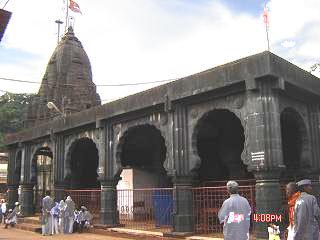
The Bhimashankar Linga at Bhimashankar in the Sahyadri Mountains of Maharashtra represents Shiva's manifestation as the supreme protector against demonic forces and the cosmic principle that transforms destructive power into spiritual virtue. The presiding deity is uniquely worshipped as Bhimashankar, a name deriving from Bhima (strength, power) and Shankar (Shiva), reflecting the temple's celebration of Shiva's supremely powerful protective aspects. The linga itself is distinguished by its exceptionally dark coloration and its unique position within a sanctuary that resonates with extraordinary spiritual power, creating an atmosphere charged with divine presence and protective grace. The sacred shrine is positioned at the source of the Bhima River, one of the major rivers of the Deccan Plateau, creating a unique convergence of natural water-based purification and the spiritual power of the Jyotirlinga. The altar arrangements and ritual structures are specifically designed to emphasize Shiva's victory over demonic forces and his eternal readiness to protect and defend those who surrender to his grace. The sanctum sanctorum maintains a cool and refreshing spiritual atmosphere that devotees describe as the direct manifestation of Shiva's protective presence enveloping and sheltering all sincere seekers. The linga is believed to be self-formed, naturally emerging from the earth at the specific location where it has been worshipped for thousands of years, its sacred lustre undiminished by the passage of time.
Mythology & Legend
The Bhimashankar temple preserves within its sacred narratives a profound story of Shiva's intervention against the demonic forces that threatened to destabilize cosmic order and dharmic principles. According to the Skanda Purana, Shiva Purana, and regional mythology, in the time of great cosmic turbulence, a fearsome demon named Bhima—of extraordinary strength and malevolent power—emerged from the depths of cosmic darkness with the express intention of disrupting the spiritual practices of sages, saints, and devout beings throughout the universe. This particular demon had obtained terrifying boons from Brahma through severe penance, making him virtually invincible and capable of causing destruction on a scale that threatened the very foundations of the dharmic order. The demon Bhima used his terrible strength to crush sacred temples, interrupt rituals, torment virtuous beings, and create such chaos and suffering that the celestial beings themselves appeared powerless before his onslaught. The god Bhima devastated the sacred locations and left in his wake only devastation, despair, and spiritual darkness. The devatas and rishis, recognizing that they lacked the power to vanquish this terrible adversary, sought refuge in Shiva and beseeched him with profound devotion and sincere invocation to intervene and protect the dharmic order from complete destruction. Moved by their pleas and by his eternal commitment to protect and uphold righteousness, Shiva took on his most terrifying and powerful form and manifested in battle against the demon Bhima. The cosmic conflict between Shiva and the demon Bhima was extraordinary and cataclysmic, shaking the very foundations of existence. In the end, Shiva's supremely transcendent power obliterated the demon, and the blood and remains of the demon merged with the sacred earth at the location that would become Bhimashankar. To commemorate both the victory and to sanctify the location, Shiva manifested himself as the Bhimashankar Linga, establishing at that spot a permanent reminder of his power to protect and destroy evil. The linga thus became established as a supremely protective shrine, capable of granting extraordinary strength and protection to those who worship there with sincere devotion.
Kshetra Mahatmya — Significance
Bhimashankar stands as one of the most sacred Jyotirlingas, located high in the Sahyadri Mountain Range of Western India, in a region that combines extraordinary natural beauty with profound spiritual potency and ancient tradition. The Skanda Purana and Shiva Purana extensively glorify Bhimashankar as a supreme kshetra where liberation from bondage and cycles of ignorance is readily obtainable through sincere devotion and spiritual practice. The shrine is positioned at the source of the Bhima River, one of the major rivers of India with its own significant role in Hindu mythology and spiritual geography. Pilgrims undertaking the journey to Bhimashankar must traverse through challenging mountainous terrain, making the physical journey itself a powerful spiritual practice that purifies and refines the devotee's consciousness and determination. The natural environment surrounding Bhimashankar—with its pristine forests, mountain peaks, and the sacred river source—provides an exceptionally conducive atmosphere for spiritual practice, meditation, and deepening communion with the divine principle embodied in the linga. The temple itself has been continuously worshipped for over one thousand years, with evidence of patronage from various Hindu kingdoms and dynasties. The sanctuary has been periodically renovated and reconstructed, incorporating elements of traditional Marathi Shikara architecture and maintaining sacred ritualistic practices that date back millennia. The presence of multiple subsidiary shrines dedicated to various aspects of Shiva and associated deities creates a comprehensive energetic ecosystem for comprehensive spiritual development. The annual Shivaratri festival is celebrated at Bhimashankar with extraordinary devotion, drawing thousands of pilgrims who congregate to celebrate the divine victory over demonic forces and to renew their commitment to dharmic principles. The presiding priesthood maintains rigorous standards of ritual purity and sacred knowledge, preserving esoteric traditions and practices that facilitate direct communion with the transcendent consciousness represented by Bhimashankar.
Blessings & Benefits
- Grants courage, strength, and protection from enemies and life obstacles.
- A bath in the sacred Bhima River followed by darshan purifies all sins of this lifetime.
- Relieves Mangal (Mars) Dosha and removes recurring conflict from one's life.
- Blesses devotees with mental peace, freedom from anxiety, and resolution of family disputes.
- Showers the grace of Shiva's fierce protective energy on all sincere pilgrims.
Temple Location
19.0726, 73.5373
Visitor Information
🕐 Timings
4:30 AM - 9:30 PM
👗 Dress Code
Traditional Indian attire
🪔 Prasad
Prasad offered at temple
🎟 Entry
Free entry
🅿️ Parking
Available at base
♿ Access
Not accessible for mobility-impaired visitors
Best Time to Visit
📅 Best Day
Monday, Maha Shivaratri
🗓 Months
Shravan (July-August), Maha Shivaratri
🌤 Season
Monsoon for scenic beauty, Winter for pilgrimage
How to Reach
🚂 Railway
Pune Junction (110 km)
✈️ Airport
Pune International Airport (127 km)
📮 Address
Bhimashankar, Khed Taluka, Pune District, Maharashtra 410509
Major Festivals
🎉 Maha Shivaratri
🎉 Shravan Somvar