🪷 Divya Desams
Govindaraja Perumal Temple
గోవిందరాజ పెరుమాళ్ ఆలయం
About the Deity
The Govindaraja Perumal Temple in Tirupati town is one of the 108 Divya Desams, enshrining Lord Vishnu in the majestic reclining posture upon the cosmic serpent Adishesha. This magnificent form of the Lord — distinct from the famous Venkateswara on Tirumala Hill — represents the eternal cosmic repose of Vishnu between cycles of creation. The deity, known as Govindaraja, reclines in supreme serenity, his dark-blue form radiating infinite peace and compassion. The presiding deity's name Govindaraja means "the king of cowherds" — a reference to Krishna's childhood in Brindavan where he tended cows. Here in Tirupati, this same divine consciousness manifests in the reclining form that represents his transcendent aspect. The divine consorts Sri Devi and Bhu Devi flank the Lord, representing wealth and earth, completing the divine household that blesses all who enter. The temple itself is a magnificent example of Dravidian architecture. The towering rajagopuram (main tower) rises impressively above the city of Tirupati, guiding pilgrims from afar. Within, the mandapas (pillared halls) display exquisite carvings depicting scenes from the Puranas. The massive reclining form of the Lord fills the inner sanctum with an overwhelming presence that silences the mind and opens the heart.
Mythology & Legend
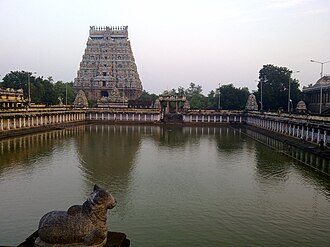
The installation of Govindaraja Perumal at Tirupati is deeply connected with the life of the great acharya Ramanujacharya. Originally, this same reclining idol of Vishnu was housed at the Chidambaram Nataraja temple, where it was a source of spiritual tension between the Shaiva and Vaishnava traditions. When the Shaiva priests of Chidambaram removed the Govindaraja idol and threw it into a tank, it was Ramanujacharya who rescued the sacred form. The great saint brought the rescued deity to Tirupati and installed him with full honors in the 12th century CE. This act of Ramanujacharya — saving the divine form and establishing it in a new sacred home — is one of the celebrated episodes of his extraordinary life. The divine will of Vishnu himself was said to guide the entire sequence of events, using the persecution in Chidambaram as the occasion to establish his presence in the sacred Tirupati valley. The Alvar saints who preceded Ramanujacharya had already celebrated this form of Vishnu in their Divya Prabandham hymns, establishing its sanctity in the Vaishnava canon. When pilgrims complete their darshan at Tirumala and then visit Govindaraja in the town below, they experience the complete spectrum of Vishnu's manifestation — the standing form on the hill and the reclining form in the valley.
Kshetra Mahatmya — Significance
Tirupati as a sacred zone encompasses both the famous Tirumala hills and the ancient town below, with Govindaraja Perumal being the presiding deity of the town itself. While millions flock to Tirumala Venkateswara on the hill, the Govindaraja temple in the town represents an equally ancient and scripturally celebrated Divya Desam. Pilgrims completing the full Tirupati pilgrimage traditionally visit both — Venkateswara on the hill for his standing, protecting form and Govindaraja in the town for his reclining, grace-bestowing form. The Govindaraja Perumal temple has been a major center of Sri Vaishnava worship since the time of Ramanujacharya. The acharya himself established the temple's ritual traditions and entrusted it to his disciples. The Tirumala Tirupati Devasthanams (TTD), one of India's most powerful religious trusts, now administers this temple along with the Tirumala shrine, ensuring that the ancient rituals are maintained with complete fidelity to the Pancharatra Agama tradition. Scriptural references in the Divya Prabandham hymns identify this location as one where Vishnu's grace flows with particular abundance. The combination of Tirupati's extraordinary spiritual heritage — as both a Char Dham site and a Divya Desam cluster — makes it one of the most merit-generating pilgrimage destinations in all of India.
Blessings & Benefits
- Darshan of Govindaraja Perumal grants liberation from the cycle of rebirth and the accumulated karma of countless lifetimes. The reclining form of the Lord, representing cosmic consciousness at rest, transmits a profound peace that settles into the devotee's consciousness and persists long after the pilgrimage is complete.
- Devotees seeking relief from the burden of unfulfilled debts — financial, karmic, or relational — find particular grace at this temple. The legend of Venkateswara taking a loan from Kubera (the god of wealth) is echoed here in the presence of Govindaraja, and pilgrims who sincerely surrender their burdens at these divine feet experience remarkable relief.
- Families facing health challenges, marriage delays, or career obstacles visit Govindaraja Perumal for specific divine interventions. The temple is known for answering sincere prayers with tangible results — a tradition maintained by devotees who return repeatedly to give thanks for blessings received.
- Students facing important examinations, professionals navigating career transitions, and seekers pursuing spiritual advancement all find that regular connection with Govindaraja accelerates their progress. The combined spiritual field of Tirupati — with both Venkateswara and Govindaraja residing here — creates an extraordinarily powerful environment for transformation and grace.
Temple Location
13.6378, 79.4199
Visitor Information
🕐 Timings
6:30 AM - 1:00 PM, 3:30 PM - 8:30 PM
👗 Dress Code
Traditional attire; dhoti for men
🪔 Prasad
Laddu, Vada, Pongal
🎟 Entry
Free
🅿️ Parking
Available
♿ Access
Accessible
Best Time to Visit
📅 Best Day
Ekadashi
🗓 Months
Brahmotsavam (October)
🌤 Season
All seasons
How to Reach
🚂 Railway
Tirupati Station (1 km)
✈️ Airport
Tirupati Airport (14 km)
📮 Address
Car Street, Tirupati, Andhra Pradesh 517501
Major Festivals
🎉 Brahmotsavam
Vaikunta Ekadashi
Janmashtami