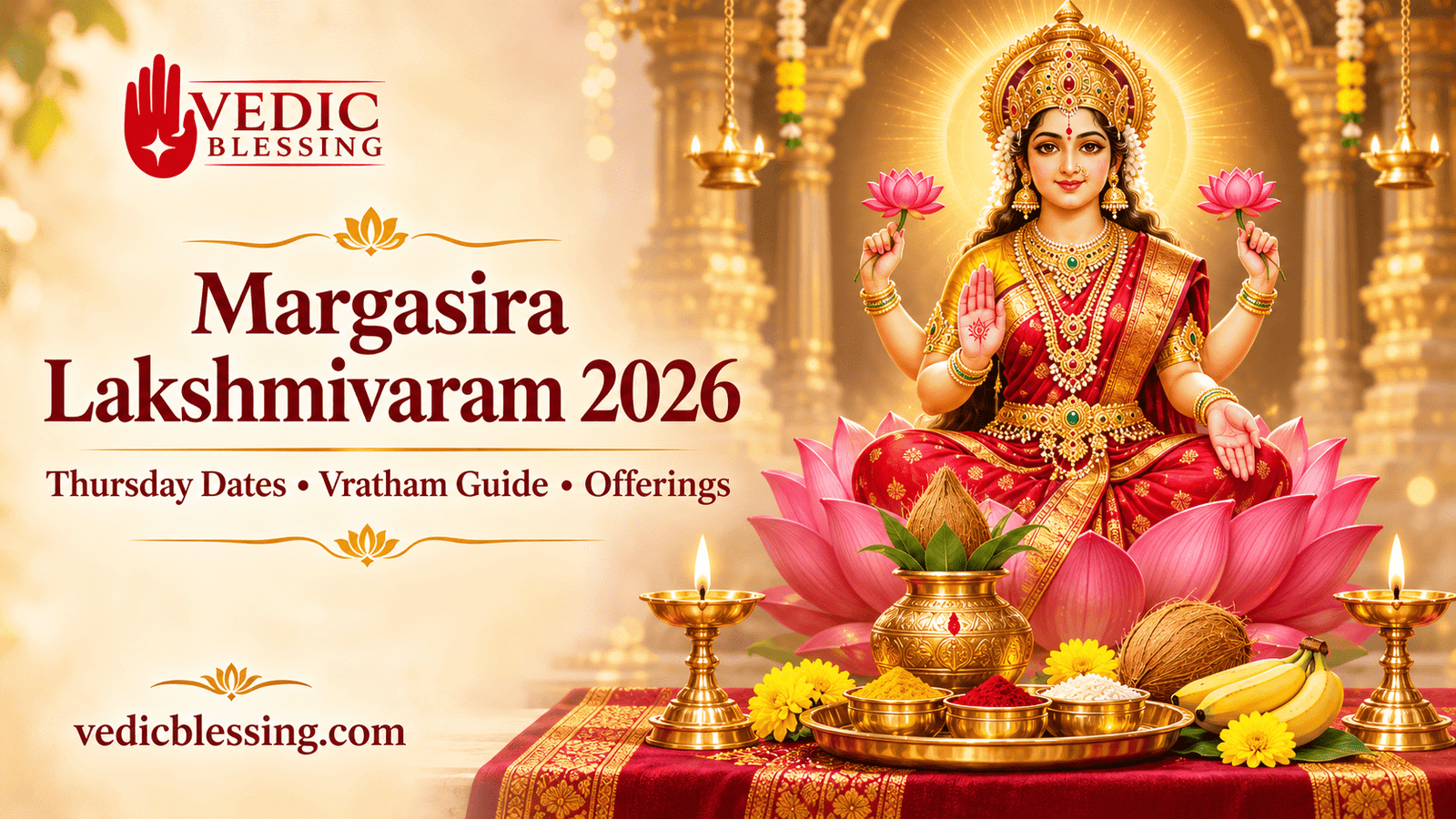
Margasira Lakshmivaram 2026: Dates, Vratham Procedure and What to Offer Each Thursday
Margasira Masam begins on Wednesday 9 December 2026, and with it the five Lakshmivarams that Telugu homes have kept for generations. If you grew up in coastal Andhra, you remember the Thursday mornings: the house washed by dawn, the kalasham dressed, pulagam on the stove, your mother or grandmother tying a thread and reading a story in which a girl's clay Lakshmi changes two households. This guide gives you the 2026 dates, the procedure, the naivedyam for each Thursday, the story, and how to keep the vratham if you live abroad.
When is Margasira Lakshmivaram 2026?
Margasira Masam 2026 runs from Wednesday 9 December 2026 to Thursday 7 January 2027 in the Telugu amanta calendar. The month has five Thursdays, so there are five Lakshmivarams this year.
First Lakshmivaram: Thursday 10 December 2026
Second Lakshmivaram: Thursday 17 December 2026
Third Lakshmivaram: Thursday 24 December 2026
Fourth Lakshmivaram: Thursday 31 December 2026
Fifth Lakshmivaram: Thursday 7 January 2027, the last day of Margasira
The dates are the same in India, the USA, Canada, the UK and the Gulf. In Australia and New Zealand the month begins one day later, on Thursday 10 December, and the Thursdays stay the same.
Why is Thursday called Lakshmivaram?
In Telugu, Thursday is Guruvaram, but it is also called Lakshmivaram, Lakshmi's day. The custom of worshipping Lakshmi on the Thursdays of Margasira is strongest in the north coastal districts of Andhra, Visakhapatnam, Vizianagaram, and Srikakulam and is kept across Andhra, Telangana and parts of Karnataka. In Maharashtra the same month's Thursdays are kept as the Margashirsha Guruvar vrat.
Why Margasira?
Because Krishna claims the month as his own. In the Bhagavad Gita, 10.35, listing the forms in which his glory is most visible, he says, "masanam margashirsho'ham", among months I am Margashirsha. A month that belongs to Vishnu is the month to welcome Lakshmi, who never stays far from him. It is also the month of harvest in the Telugu country; the new rice comes home, and the first offerings of it go to the goddess of abundance.
What is the story behind the vratham?
Every Thursday the vratha katha is read after the pooja, and it is a story about a girl, not a king.
A motherless girl grew up under a harsh stepmother. The village priest told her to worship Lakshmi and her troubles would ease. She made a small Lakshmi out of clay and worshipped it every Thursday with whatever she had; the only offering her stepmother would give her was a piece of jaggery. When she married, she carried the clay Lakshmi to her husband's house. That house prospered. Her father's house sank into poverty.
She tried to help. She sent her brother home with a walking stick filled with gold coins; he lost it on the way. Then slippers filled with coins; lost. Then a pumpkin filled with gems; lost. Wealth, the story says, does not travel to a house where Lakshmi is not welcomed.
So she went herself and asked her stepmother to keep the Lakshmivaram vratham. The first Thursday, the stepmother ate a morsel of leftover rice while feeding the children. The second, she oiled her hair with leftover oil. The third and fourth, she broke the rules again. On the fifth Thursday the daughter tied her mother's saree end to her own and guided her through every step. When the purnam boorelu were offered, the goddess accepted the daughter's and refused the stepmother's. The reason: years earlier, when the little girl had played with the goddess's doll, the stepmother had beaten her with a broom. A girl in the house is Lakshmi's own form, and the goddess had not forgotten. The daughter made her mother ask forgiveness. Only then did Lakshmi accept the offering, bless the house, and disappear.
Read it once and you see what the vratham is really asking: cleanliness, discipline, and kindness to the girls and women of the house.
How do you perform the Margasira Lakshmivaram vratham?
The pooja is the standard Lakshmi vratham, the same shape as Varalakshmi and Deepavali Lakshmi pooja. What changes is the naivedyam.
The evening before: Clean the house, especially the pooja room and kitchen. Wash the pooja vessels. Decide the naivedyam and keep the ingredients ready.
Thursday morning: Bathe early. Draw a muggu at the door and in the pooja room. Place a wooden plank, cover it with a clean cloth, and spread rice on it.
Kalasham: Fill a kalasham with water, add a coin, betel nut, turmeric, akshatalu and a few drops of milk. Place mango leaves around the rim and a coconut smeared with turmeric on top. Dress it with a small blouse piece and a garland. Place it on the rice. Keep Lakshmi's picture or idol behind it.
Ganapathi pooja first: A short worship of Ganapathi with akshatalu and a piece of jaggery or a banana.
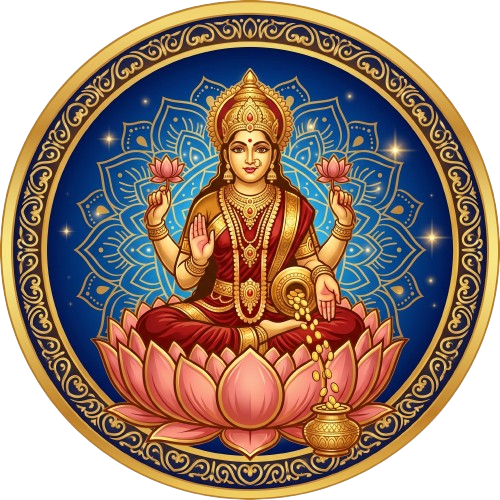
Lakshmi pooja: Sankalpam with your gotra and the names of the family. Then shodashopachara pooja, the sixteen offerings, with the Sri Lakshmi Ashtottaram, 108 names, offering kumkum at her feet with each name. Light the lamp with ghee. Offer flowers, especially lotus or any red flower, and tamalapakulu.
Naivedyam: The dish of that Thursday, set before the goddess with a glass of water and a piece of jaggery.
Toram: Tie the yellow thread with nine knots on the right wrist.
Katha: Read or listen to the Margasira Lakshmi vratha katha. The vratham is counted complete only when the story is read.
Harati and prasadam: Karpura harati, then share the naivedyam. Invite married women and girls for pasupu kumkuma and give tamalapakulu, a fruit and a small gift. In this vratham the guests matter; the story is about honouring the girls of the house.
Fast: Most families take one meal after the pooja and avoid rice at night. Do what your family has always done; the vratham has no single rule on fasting.
What do you offer each Thursday?
This is the part that makes Margasira Lakshmivaram different from every other Lakshmi vratham. A different naivedyam each week, in this order.
First Thursday, 10 December: Pulagam. Rice and moong dal cooked together with ghee, pepper and cumin.
Second Thursday, 17 December: Ksheerannam, also called palannam. Rice cooked in milk, lightly sweetened.
Third Thursday, 24 December: Kudumulu. Steamed rice-flour dumplings, sweet with jaggery or plain with a pinch of salt.
Fourth Thursday, 31 December: Paramannam. Rice payasam with jaggery, ghee, cashew and raisins.
Fifth Thursday, 7 January: Purnam boorelu. Deep-fried dumplings with a chana dal and jaggery filling, the offering the goddess accepts in the katha.
The sequence moves from the plainest dish to the richest. Abundance, in this vratham, is built week by week.
What if there are only four Thursdays?
In years when Margasira has only four Thursdays, the fifth Lakshmivaram is kept on the first Thursday of Pushya Masam. In 2026 the month has five, so the vratham completes inside Margasira on 7 January. There is no udyapana, no formal closing; families keep it every year, for as long as they wish.
Who performs the vratham?
Traditionally the women of the house, often together, and girls join from a young age. There is no bar on men; many households do it as a family. Newly married women often begin it in the first Margasira after their wedding.
How do you keep Margasira Lakshmivaram abroad?
Thursday is Thursday. The dates are the same in the USA, Canada, the UK and the Gulf. Do the pooja in the morning before work or in the evening; the day matters, the hour does not.
The naivedyam is easy. Every one of the five dishes needs only rice, moong dal, milk, jaggery, rice flour and chana dal. All of it is in any Indian store, and most of it in a regular supermarket.
No Lakshmi idol? The girl in the story made hers from clay. A picture, a silver coin with Lakshmi, or a turmeric cone on a betel leaf all serve.
No one to call for pasupu kumkuma? Give it to the women and girls in your own home, or send a small gift to a friend. The intent is the offering.
Keep the story. Read the katha to your children in English if they cannot follow Telugu. It is the part of the vratham they will remember.
What else falls in Margasira 2026?
Subrahmanya Shashti: Tuesday 15 December. Sacred to Subrahmanya; Telugu and Kannada families worship at his temples and at home.
Dhanurmasam begins: Wednesday 16 December, when the sun enters Dhanu. Pre-dawn Vishnu worship and the Tiruppavai begin.
Mokshada Ekadashi, kept as Vaikuntha Ekadashi: Sunday 20 December. Confirm the Uttara Dwara Darshanam timing with your temple.
Margasira Pournami, Dattatreya Jayanti: Wednesday 23 December.
Margasira Amavasya, month ends: Thursday 7 January 2027, which is also the fifth Lakshmivaram.
Frequently Asked Questions
When does Margasira Lakshmivaram start in 2026?
Thursday 10 December 2026. Margasira Masam begins on Wednesday 9 December, and the first Thursday is the 10th.
How many Lakshmivarams are there in 2026?
Five: 10, 17, 24 and 31 December 2026, and 7 January 2027.
I missed the first Thursday. Can I start from the second?
Yes. Begin on the next Thursday with a sankalpam and continue through the fifth. The vratham has no rule that you must begin on the first.
What is the naivedyam for the first Margasira Thursday?
Pulagam, rice and moong dal cooked together. The five Thursdays go pulagam, ksheerannam, kudumulu, paramannam and purnam boorelu.
Can I do the pooja in the evening?
Yes. Morning is traditional, but families abroad and working women often do it in the evening on the same Thursday. The day is what the vratham asks for.
Can men perform Margasira Lakshmi vratham?
Yes. It is kept mostly by women by custom, but there is no restriction. Many families do it together.
What if my periods fall on a Thursday?
Skip that Thursday's pooja and continue from the next one. Ask another woman in the house to keep the kalasham that week if you wish. No prayaschittam is needed.
Is there an udyapana at the end?
No. Margasira Lakshmivaram has no formal closing. Families repeat it every year for as long as they wish.
Is this the same as the Marathi Margashirsha Guruvar vrat?
Same month, same day, same goddess, different regional procedure. The Telugu vratham has its own katha and the five-dish naivedyam sequence.
Why did Lakshmi refuse the stepmother's offering in the story?
Because she had once beaten the girl for playing with the goddess's doll. The katha's point is that Lakshmi lives in the girls and women of a house, and the vratham fails where they are not treated well.
Begin This Margasira With Us
If you are far from the women who taught you this vratham, or doing it for the first time with no one to guide you, our pandits can perform the Margasira Lakshmi pooja live for your family on any of the five Thursdays, in your name and gotra, with the kalasham, the Ashtottaram, the naivedyam of that week and the katha, while you sit before your own pooja shelf. Book one Thursday or all five.
Book at vedicblessing.com. WhatsApp +91 9063082668. Email support@vedicblessing.com.
Observe this with a live puja
Our pandits perform pujas live on video in your name and gotra. You can also check today's Panchang and auspicious dates for your city.