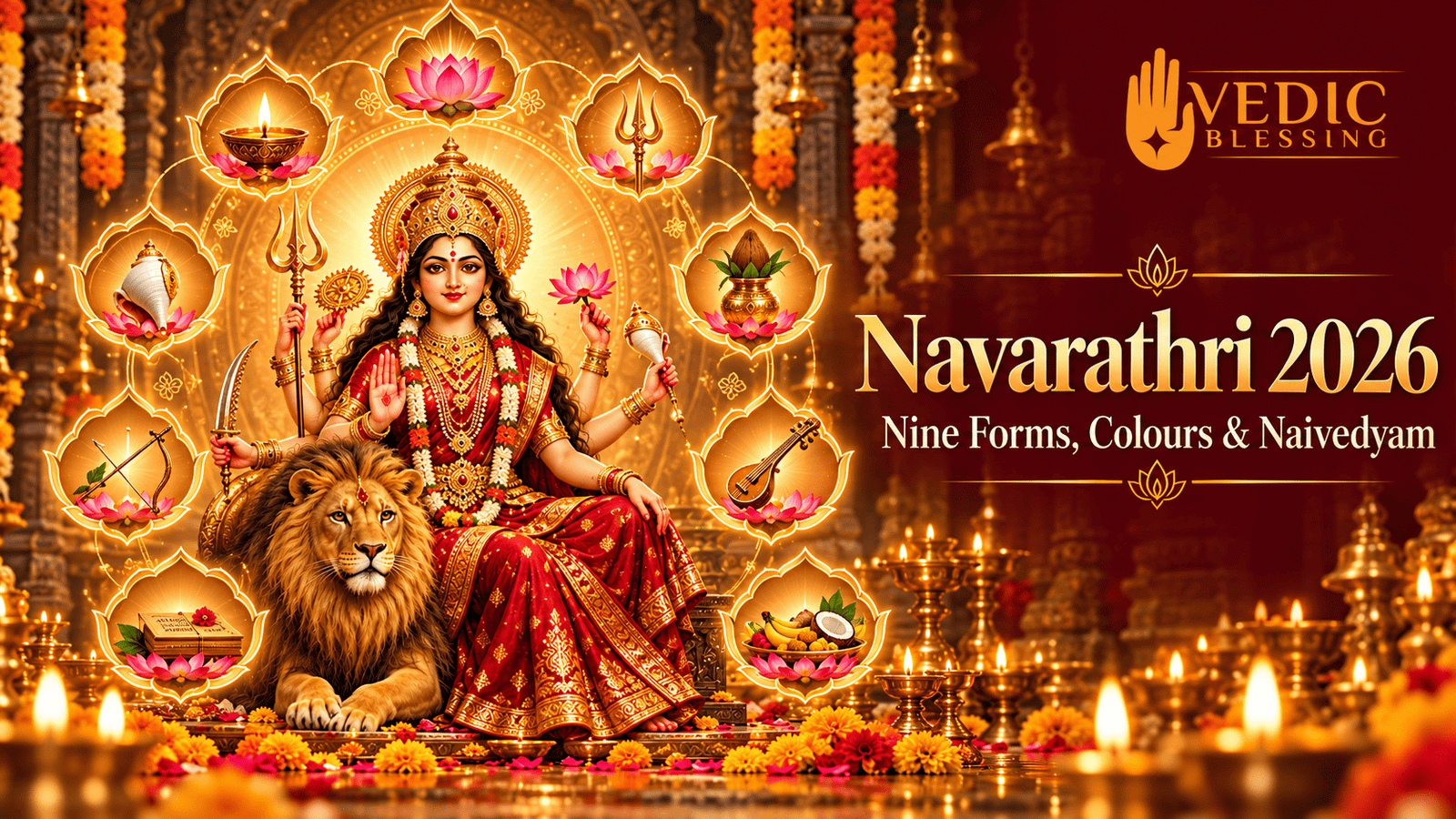
Navarathri 2026 Day-by-Day Guide: Nine Forms of the Goddess, Colours, Naivedyam and Their Meaning
A lamp is lit. Flowers are placed before the Goddess. In many homes, someone asks the same question each evening: “Which form of Amma do we worship today?”
Navarathri gives us nine nights to answer that question. Each form of the Goddess tells a story and offers something to think about in our own lives. One reminds us to begin with courage. Another teaches patience. Another helps us face what we fear.
This guide follows the Navadurga tradition, with a colour and a naivedyam suggestion for each day. Colours and food offerings vary among regions and families, so you can always follow the custom passed down in your home.
When is Navarathri in 2026?
Sharad Navarathri begins on 11 October 2026, and Vijayadashami falls on 20 October 2026 in the Vijayawada calendar. The 2026 calendar includes a repeated Saptami tithi, so the dates of specific pujas do not line up neatly with a simple “one tithi, one date” chart. If your family observes Ashtami or Navami puja at a particular time, check the panchang for your location.
What do the nine days teach us?
The nine Navadurga forms are more than nine names to remember. Together, they take us through a journey of devotion: finding our footing, practising patience, gathering courage, caring for others, facing difficulties, and seeking wisdom.
You can read one section each day with your family. Tell the story, offer what is customary in your home, and ask one simple question: “What can we learn from the Goddess today?”
Day 1: Shailaputri, the strength to begin
2026 calendar colour: Orange
Navadurga naivedyam suggestion: Ghee
Shailaputri means “daughter of the mountain.” In the traditional account, Goddess Parvati is born as the daughter of Himalaya. The image of a mountain gives us a way to understand her first lesson: stand firm, even when you are beginning something uncertain.
The first day of Navarathri is a chance to make a quiet intention. It may be to pray regularly, speak more patiently, or bring the family together for a few minutes each evening. Great changes often begin with one steady step.
How to observe at home: Light a lamp, offer flowers, and share one intention for the nine days. In one Navadurga naivedyam tradition, ghee is offered to Shailaputri.
Day 2: Brahmacharini, the power of patience
2026 calendar colour: White
Navadurga naivedyam suggestion: Sugar
Brahmacharini represents devotion, discipline, and perseverance. She reminds us that some worthwhile things cannot be rushed. Learning, healing, prayer, and personal growth all ask us to keep going, even when progress feels slow.
Her story is especially meaningful in a world where we expect quick answers. The second day invites us to slow down and give our full attention to what matters.
How to observe at home: Spend a few quiet minutes in prayer. You may offer sugar if it is part of the practice you wish to follow. Ask your family, “What is one good habit we want to continue?”
Day 3: Chandraghanta, courage with calmness
2026 calendar colour: Red
Navadurga naivedyam suggestion: Kheer or payasam
Chandraghanta is recognised by the crescent moon on her forehead. Her form is associated with courage and protection. She teaches a powerful lesson: being courageous does not mean we never feel afraid. It means we find the strength to act wisely despite our fear.
Think of someone speaking up for another person, beginning again after a disappointment, or facing a difficult conversation with kindness. Courage can look like any of these things.
How to observe at home: Offer flowers and, if suitable for your family, prepare kheer or payasam. Share a story about a time someone in your family showed courage.
Day 4: Kushmanda, light in a difficult moment
2026 calendar colour: Royal blue
Navadurga naivedyam suggestion: Malpua
Kushmanda is associated with the energy of creation and the light that drives away darkness. Her name encourages us to think about what we bring into our homes and communities. A word of encouragement, a welcoming meal, or help given at the right moment can change someone’s day.
On the fourth day, pray for the energy to create something good, however small it may seem.
How to observe at home: Light the evening lamp with your family. Malpua is offered in one Navadurga naivedyam tradition; you may follow your own household offering instead. Do one thoughtful thing for someone today.
Day 5: Skandamata, love that gives strength
2026 calendar colour: Yellow
Navadurga naivedyam suggestion: Banana
Skandamata is the mother of Skanda, also known as Kartikeya. Her form expresses care and protection. She reminds us of the people who supported us while we were growing and of the responsibility we have to care for others.
Navarathri is also a lovely time to thank the mothers, grandparents, teachers, and elders who helped us learn our traditions. Sometimes the most meaningful celebration begins with a phone call.
How to observe at home: A banana is a simple naivedyam suggestion associated with Skandamata. Invite a child to place it near the prayer space, then tell them about someone who cared for you when you were young.
Day 6: Katyayani, the courage to do what is right
2026 calendar colour: Green
Navadurga naivedyam suggestion: Honey
Katyayani is a powerful form of the Goddess associated with the battle against Mahishasura. Her strength has a purpose: to confront harm and uphold what is right.
We can reflect on that strength in everyday life. It may mean setting a fair boundary, admitting a mistake, or helping someone who needs support. Katyayani reminds us to use our energy with clarity and good intention.
How to observe at home: Honey is one suggested offering in the Navadurga tradition. During prayer, ask for the strength to handle a challenge wisely.
Day 7: Kalaratri, facing the darkness
2026 calendar colour: Grey
Navadurga naivedyam suggestion: Jaggery
Kalaratri’s fierce appearance can be startling, but her form speaks to anyone who has faced uncertainty. There are times when we cannot simply wish a problem away. We must look at it, seek help when needed, and take the next step.
Her day reminds us that difficult moments do not last forever. Prayer can give us steadiness while we work through them.
How to observe at home: Offer jaggery if it suits your custom. Take a quiet moment to name a worry and pray for the courage to face it.
Day 8: Mahagauri, a moment of renewal
2026 calendar colour: Purple
Navadurga naivedyam suggestion: Coconut
Mahagauri is associated with peace and purity. After the strength of Kalaratri, her gentle form feels like a moment to pause and breathe. She invites us to let go of a harsh word, forgive where we can, and begin again with a clearer heart.
Families can use this day to bring warmth back into an ordinary routine. Sit together for the evening prayer, share prasadam, and enjoy a little unhurried time.
How to observe at home: Coconut is a naivedyam suggestion associated with Mahagauri. You can also offer fruit according to your family’s practice.
Day 9: Siddhidatri, wisdom to carry forward
2026 calendar colour: Peacock green
Navadurga naivedyam suggestion: Sesame seeds
Siddhidatri is associated with spiritual fulfilment and wisdom. The ninth form brings us back to the question we began with: what have these days taught us?
Perhaps the family prayed together more often. Perhaps a child learned one name of the Goddess. Perhaps someone remembered a song their grandmother used to sing. These may be small moments, but they are how traditions stay alive.
How to observe at home: Sesame seeds are suggested in one Navadurga offering tradition. Thank the Goddess for the nine nights and choose one practice you would like to continue after the festival.
The daily colours above follow a popular 2026 calendar colour custom. The listed naivedyam suggestions follow one Navadurga offering tradition. Neither is a required offering for every temple or household.
Why are Vijayawada’s Kanaka Durga alankarams different?
If you visit Sri Kanaka Durga Temple in Vijayawada during Dasara, you may see names and offerings different from this Navadurga guide. The temple celebrates Ammavaru through its own daily alankarams, including forms such as Sri Gayatri Devi, Sri Annapurna Devi, and Sri Lalitha Tripura Sundari Devi.
That is the beauty of a living tradition. A general Navadurga guide can help families learn the nine forms, while devotees following Kanaka Durga Temple can observe the temple’s announced alankaram and naivedyam for that day.
How can you celebrate when you live away from home?
You do not need to recreate every detail of a temple celebration to make Navarathri meaningful at home. Choose a clean space for prayer, light a lamp, offer flowers or fruit, and spend a few minutes together.
If you have children, let them participate. Ask them to choose a flower, listen to a story, or share what courage and kindness mean to them. If your parents or grandparents are far away, call them and ask how they celebrated when they were young. Their answer may become your family’s favourite part of the festival.
Bring your family together in prayer this Navarathri
The colours brighten our days, and prasadam brings everyone to the table. At the heart of Navarathri is the time we make for the Goddess and for one another.
If you would like guidance for your family’s prayer, VedicBlessing offers a live online Durga Puja conducted by an experienced Vedic priest. Your family can join through Zoom, take part from wherever you live, and include your names and prayer intention in a personalised sankalpa.
Choose your preferred date and time, and book your Navarathri Durga Puja here:
https://www.vedicblessing.com/service/navarathri-durga-puja
May these nine nights give your family stories to share, strength to draw on, and a tradition to carry forward.
Frequently Asked Questions
1. When does Navarathri 2026 begin?
Sharad Navarathri begins on 11 October 2026, and Vijayadashami falls on 20 October 2026 in the Vijayawada calendar. Puja timings should be checked for your location.
2. Why are nine forms of the Goddess worshipped?
The Navadurga tradition honours nine forms of the Divine Mother. Each form helps devotees reflect on a quality such as patience, courage, compassion, or wisdom.
3. Does each Goddess have a fixed colour?
No. The colours in this guide follow a popular 2026 calendar custom. They are a way to participate in the celebration, not a requirement for worship. Your family or temple may follow different colours.
4. Is the suggested naivedyam compulsory?
No. The offerings listed here come from one Navadurga tradition. You can follow your family’s custom or offer a simple fruit or other suitable naivedyam.
5. Why does the 2026 calendar show Saptami on two dates?
A lunar tithi does not always begin and end within one calendar day. In the Vijayawada panchang, Saptami appears on both 17 and 18 October. For a puja tied to Ashtami or Navami, follow the timing for your location rather than relying only on the numbered day in a nine-day guide.
6. Are the nine Navadurga forms the same as Vijayawada Kanaka Durga Temple’s alankarams?
No. Sri Kanaka Durga Temple follows its own Dasara alankaram schedule. If you observe the temple’s tradition, use its announced daily form and naivedyam.
7. Can I celebrate Navarathri at home without an elaborate setup?
Yes. You can prepare a clean prayer space, light a lamp, offer flowers or fruit, and spend a few minutes in prayer with your family. Follow the practices that are meaningful in your home.
8. Can family members living in different countries join the same puja?
Yes. VedicBlessing’s live online Durga Puja allows family members to join through Zoom from their respective locations.
9. What details are needed for a personalised sankalpa?
You can share the names of the family members to be included, their gotram and nakshatra if known, your location, and your prayer intention.
10. How do I book a Navarathri Durga Puja with VedicBlessing?
Visit https://www.vedicblessing.com/service/navarathri-durga-puja and choose your preferred date and time. An experienced Vedic priest will conduct the puja live, so your family can participate from wherever you are.