Nagula Chavithi 2026: Why We Pour Milk at the Anthill, and the Story of Adishesha
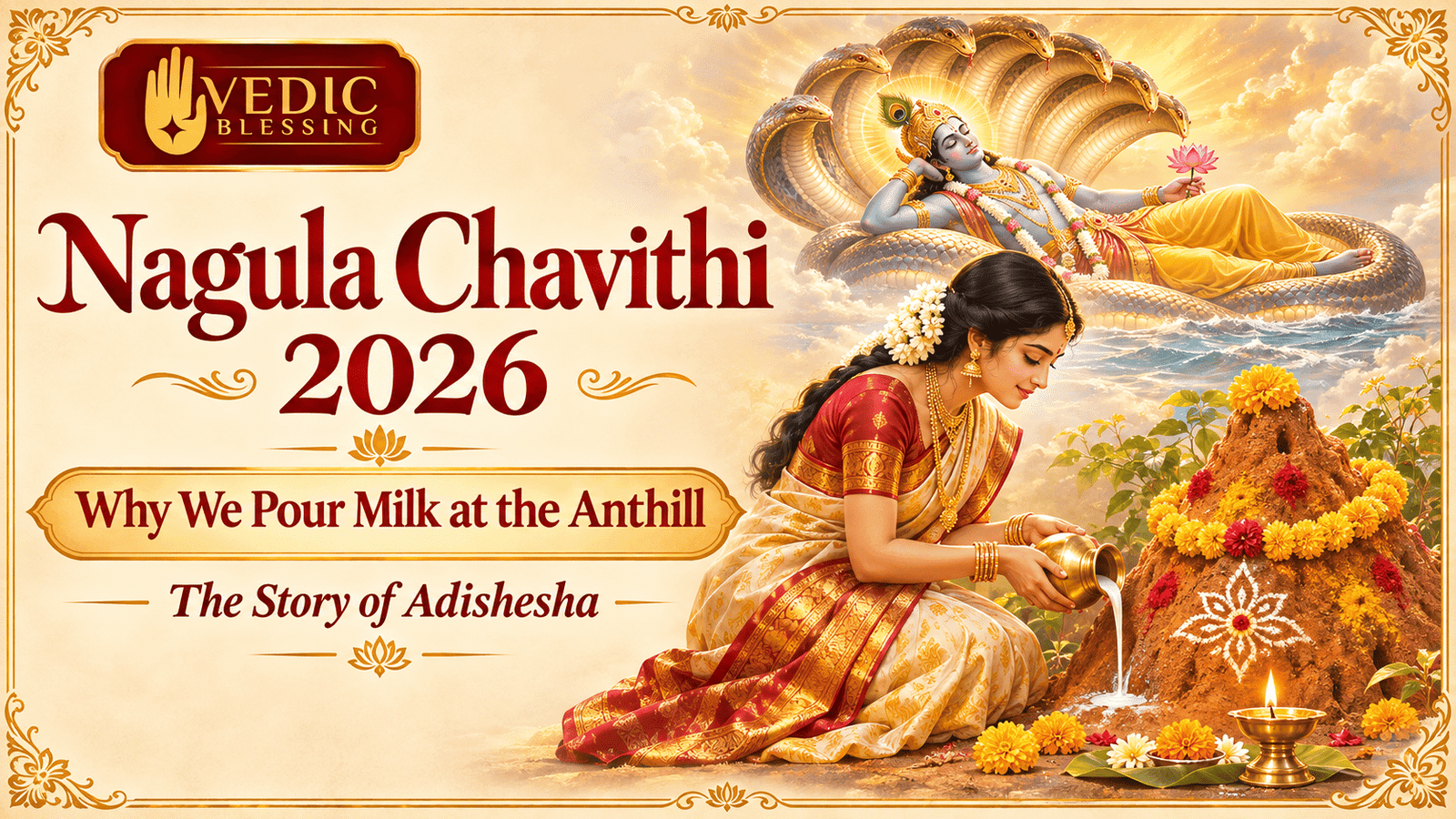
Nagula Chavithi 2026 falls on Friday, 13 November in India and Thursday, 12 November abroad. Once a year, on Karthika Shuddha Chavithi, Telugu women walk to an anthill with a vessel of milk. Here is why they go, what they do there, and how the serpent earned a seat beside every god.
When Is Nagula Chavithi 2026?
Nagula Chavithi is observed on the fourth day of the bright half of Karthika, Karthika Shuddha Chavithi. In 2026 that is Friday, 13 November in India. In the USA, UK and Canada the tithi falls a day earlier, on Thursday, 12 November.
It is a Telugu festival, kept in Andhra Pradesh and Telangana and by Telugu families everywhere, three days after Deepavali and four days into Karthika Masam. It is observed mainly by women, married and unmarried, for the protection of their children and family. The deity is the Naga, the serpent, and the offering is milk, poured into an anthill.
Why Does Every Deity Keep a Serpent So Close?
Look at any pooja shelf. Vasuki rests on Shiva's neck. Adishesha is the bed Vishnu sleeps on. A serpent circles Ganesha's waist. Subrahmanya is worshipped in serpent form. Before asking why we pour milk at an anthill, it is worth asking how the serpent came to sit beside every god.
The Nagas were a people. In the Mahabharata the Nagas are not animals but a race, the children of the sage Kashyapa and his wife Kadru. Vasuki, Takshaka and Shesha were brothers. They had kings, cities and a realm of their own, Patala. Arjuna married a Naga princess, Ulupi. Historians read this as the memory of serpent-worshipping peoples of ancient India who were taken into the Vedic fold rather than driven out.
Shesha earned his place through tapas. When Kadru asked her sons to help her cheat in a wager, Shesha refused. Ashamed of his brothers, he left them and went into tapas at Gandhamadana, Badari and Pushkara, for so long that his body dried to skin and bone. Brahma came to him and asked what he wanted. Shesha asked for one thing only: that his mind stay fixed in dharma and never turn to his brothers' ways. Brahma granted it and gave him a task, to hold the earth steady on his head. From that tapas Shesha became Ananta, the endless one, and Vishnu's bed. He was not born to that place. He chose dharma and earned it.
Vasuki earned his through service. At the churning of the ocean of milk, Vasuki offered himself as the rope around Mount Mandara and bore the strain of devas and asuras pulling from either side. For that service Shiva took him as an ornament.
What the serpent stands for. The serpent is not greater than God. It is the symbol of power, raw and dangerous, and God is the one who holds that power calmly. Shiva wears Vasuki; Vasuki does not wear Shiva. The same energy, the yoga texts say, lies coiled and asleep at the base of every human spine. They call it kundalini. Shiva has mastered it and wears it as a jewel. With dhyanam and pranayama, slowly and under a guru, we can bring it under control too.
That is the picture behind Nagula Chavithi. We do not pour milk at the anthill out of fear. We pour it out of respect for the power that runs beneath everything.
Why the Anthill, Why Milk, Why No Fire?
Why the anthill? The putta is the Naga's home. In the tradition the Nagas are the guardians of what lies beneath the earth: its hidden wealth, its water, the roots of every crop. Pouring milk into the anthill is thanking the ones who keep the ground fertile. The anthill is also the one place where the serpent lives among us without harm, so it became his shrine.
Why milk? Milk is sattvik and cooling. The belief is that milk offered to the serpent calms his venom, and in the same way the offering calms the fear we carry of him. Turmeric, kumkum, flowers, a cotton thread garland and chalimidi go with it.
Why no fire, no knife, no digging? On Nagula Chavithi the stove is not lit, no knife is held, and the earth is not dug. The reason is simple: on the Naga's day, no harm should come to a Naga. Fire, blades and spades are what hurt a serpent. So the day's food is uncooked, chalimidi, vadapappu, bananas and coconut, prepared the night before.
How to Observe Nagula Chavithi
- The evening before. Prepare chalimidi (rice flour and jaggery), vadapappu (soaked moong dal), and keep milk, turmeric, kumkum, flowers, a cotton thread, bananas and a coconut ready. Nothing will be cooked tomorrow.
- Morning. Bathe before sunrise. Fast until the milk is offered. Dress in traditional clothes; many women wear a fresh sari for the day.
- At the anthill. Go with the family, usually with the children. Clean the base of the putta, apply turmeric and kumkum around its mouth, and lay the cotton thread on it.
- The offering. Pour the milk slowly into the anthill, saying the Naga's names: Ananta, Vasuki, Takshaka, Karkotaka, Shankha, Kulika, Padma, Mahapadma. Offer flowers, chalimidi and vadapappu. Light a small lamp if the custom in your family allows.
- The prayer. Ask for the protection of the children, the health of the family, and freedom from fear. Many mothers touch a little earth from the anthill to the child's ear and stomach for protection.
- Breaking the fast. Eat chalimidi and vadapappu first, then the rest of the uncooked meal. The stove stays cold all day.
- Evening. A lamp at the Tulasi and at the door, as every day in Karthika.
How to Observe It at Home or Abroad
No anthill in Dallas or Dubai. That is fine. The anthill is the ideal, not the rule.
Keep a Naga idol or a picture of Nagendra on the pooja shelf. Do abhishekam with milk, then apply turmeric and kumkum and offer flowers, chalimidi and vadapappu exactly as you would at the putta. Say the eight Naga names. The fast, the uncooked meal and the cold stove are the same.
In Telugu tradition Subrahmanya is worshipped in serpent form, which is why the Mopidevi temple in Krishna district is a Subrahmanya temple with a serpent as the deity, and why many families offer the Nagula Chavithi milk to a Subrahmanya image. Either is correct.
If your parents in India are going to the putta, ask them to pour a little milk in your name. That is how the custom has always travelled.
Who Observes Nagula Chavithi, and For What?
Mothers, above all. The vratam is for the health and long life of children, and the touch of anthill earth on a child's ear is the day's most tender custom. Couples hoping for a child. The Naga is the keeper of lineage, and santanam is the oldest prayer at the putta.
Anyone with Naga dosha in the horoscope. Nagula Chavithi is the day the tradition sets aside for easing it; the section below explains what it is. Unmarried girls, who observe it for a good husband and a happy home, the way they keep Atla Taddi a fortnight earlier.
And whole families, simply because their mothers and grandmothers did. That reason is as good as any.
Two Thousand Years of Serpent Worship in Andhra
Serpent worship is older than most of our temples. The Amaravati stupa in Guntur district, built between the 2nd century BCE and the 3rd century CE, carries serpent carvings on its railings, including the Naga king Muchalinda sheltering the Buddha. When Buddhism flourished on the Krishna, the Nagas were already sacred here.
Older still are the nagakallu, the serpent stones set under peepal and neem trees in nearly every Telugu village, where women still pour milk and light lamps. Scholars date the custom to before the Vedic period. When the great deities arrived, the serpent was not discarded. He was placed on Shiva's neck and under Vishnu's back. That is how our tradition has always grown, by including rather than replacing.
So when you pour milk at the putta this Friday, you are doing what people on this same land did two thousand years ago.
What Is Naga Dosha?
In Vedic astrology, Rahu and Ketu are the shadow planets, and together they are the serpent: Rahu the head, Ketu the body. When they sit in certain houses of the birth chart, especially the 5th, 7th or 8th, or when all the other planets lie between them, which is Kala Sarpa Yoga, astrologers call it Naga dosha or Sarpa dosha.
It is linked in the tradition to delays in marriage, difficulty having children, recurring fear or restlessness, and obstacles that keep returning. It is not a curse and it is not permanent. The remedies are gentle: Nagula Chavithi and Naga Panchami observances, milk at the putta, a lamp to Subrahmanya on Tuesdays, Rahu-Ketu mantras, and, where an astrologer advises it, a Naga Dosha Shanti or Sarpa Dosha Nivarana puja performed once in the person's name.
Nagula Chavithi is the day the calendar gives for it. If you have been told you have Naga dosha, or want to know, a Janma Kundali reading will show where Rahu and Ketu sit and whether any shanti is needed. Many charts have no dosha at all, and knowing that is a relief in itself.
Frequently Asked Questions
When is Nagula Chavithi in 2026? Friday, 13 November in India, on Karthika Shuddha Chavithi. In the USA, UK and Canada it is Thursday, 12 November.
What is the difference between Nagula Chavithi and Naga Panchami? Both honour the Nagas. Naga Panchami falls in Shravana (July or August) and is observed across India. Nagula Chavithi falls in Karthika and is a Telugu observance, kept on the fourth day after Deepavali.
Why is milk poured into the anthill? The anthill is the Naga's home, and milk is believed to calm the serpent's venom. It is an offering of gratitude to the guardians of the earth's wealth and water.
Why is no cooking done on Nagula Chavithi? So that no fire, blade or digging harms a Naga on his day. The food, chalimidi and vadapappu, is prepared the evening before.
Can I observe Nagula Chavithi without an anthill? Yes. Pour milk over a Naga or Subrahmanya idol at home, with the same offerings and the same fast. This is how it is kept abroad.
What is chalimidi? A sweet of rice flour and jaggery, uncooked, traditional for Nagula Chavithi and Atla Taddi.
Who is the deity of Nagula Chavithi? The Naga devatas, led by Adishesha and Vasuki. In Telugu tradition Subrahmanya is worshipped in Naga form, so his image receives the offering too.
What is Naga dosha and does Nagula Chavithi remove it? Naga dosha is a Rahu-Ketu placement in the birth chart linked to delays in marriage and children. Nagula Chavithi observance is a traditional remedy; a Naga Dosha Shanti puja is advised where an astrologer finds the dosha strong.
What to Do This Nagula Chavithi
Prepare the chalimidi and vadapappu on Thursday evening. On Friday morning, bathe, fast, and take the milk to the putta or to the Naga image at home. Say the eight names, pour the milk, ask for your children's protection, and keep the stove cold till evening.
If you have been told you have Naga dosha, or want your chart read, book an astrology consultation at vedicblessing.com. A Naga Dosha Shanti or Sarpa Dosha Nivarana puja can be performed live by our pandits in your name and gotra, wherever you are.
Questions? WhatsApp +91 9063082668 or email support@vedicblessing.com
- Mahabharata, Adi Parva, chapters 36 and 37 (Shesha's tapas and Brahma's boon)
- Bhagavata Purana, Canto 8 (Vasuki at the churning of the ocean)
- Amaravati stupa, Archaeological Survey of India, 2nd century BCE to 3rd century CE