Mahalaya Paksham 2026: Meaning, History, the Story Behind It, and How to Perform Shraddham from Anywhere
Once a year, the calendar sets aside a full fortnight for the people who came before us. Not a festival, not a celebration — a quieter obligation, and in many families the most solemn one of the whole year.
This is Mahalaya Paksham. Below is what it means, where it comes from, the story that explains why it exists, and what to do if you are far from home when it arrives.
What does Mahalaya Paksham mean?
The word breaks into two parts. Maha means great. "Alaya" means "abode" or “dwelling.” Mahalaya is the great abode, the realm where the departed are believed to reside.
Paksham means fortnight. The lunar month has two halves: the bright fortnight as the moon waxes and the dark fortnight as it wanes. Mahalaya Paksham is the dark fortnight of Bhadrapada masam, the sixteen tithis given over to the ancestors.
You will hear it called by other names depending on where the family is from. Pitru Paksha across much of India. Sorah Shraddha in the north, meaning the sixteen shraddhas. Pitru Pandharvada in Maharashtra. In Telugu homes the final day is simply Peddala Amavasya, the new moon of the elders.
Different names, one meaning: this is the time the ancestors are remembered together.
Why does this fortnight exist? The story of Karna
The story most often told about Mahalaya Paksham comes from the Mahabharata tradition, and it is worth telling properly because it explains the entire logic of the fortnight.
Karna was the most generous man of his age. Whatever was asked of him, he gave. Gold above all, he gave away gold every single day of his life and never once refused a person who came to him.
When Karna died on the battlefield of Kurukshetra and reached the world beyond, he was received with honour. A great feast was laid before him. But when he reached for the food, it turned to gold in his hands. Plate after plate, gold. He could not eat.
Bewildered, he asked why.
The answer he received was this: all your life you gave gold, and gold is what you receive. But you never once offered food and water in the name of your ancestors. You gave endlessly to the living and forgot the ones who gave you life.
Karna's reply was honest. He had not known. He had been raised by a charioteer and his wife, had learned of his true lineage only at the very end, and had never been taught the rites owed to a line he did not know he belonged to.
The ignorance was accepted. Karna was granted sixteen days to return to earth, and in those sixteen days he offered food and water in his ancestors' names and completed what he had left undone.
Those sixteen days are Mahalaya Paksham.
What the story is actually saying is not about Karna's failure. It is about the two directions a life faces. Charity flows forward to those still living. Shraddham flows backward to those who made your living possible. A life that only gives forward is incomplete, however generous it looks from outside.
The other belief attached to this fortnight is that Yama releases the departed from Pitru Loka for these sixteen days so that they may receive what their families offer. On the final Amavasya they return. That is why the Amavasya is the most important day of all and why the fortnight has a fixed beginning and a fixed end.
When is Mahalaya Paksham in 2026?
Mahalaya Paksham 2026 runs from Sunday, September 27 to Saturday, October 10.
Mahalaya Amavasya, or Peddala Amavasya, falls on Saturday, October 10, 2026. This is the single most important day of the fortnight.
Bhadrapada Purnima Shraddha falls the day before, on Saturday, September 26. It is closely associated with the fortnight and is why you will sometimes see the period described as sixteen days, but strictly it sits just outside Pitru Paksham, which runs Pratipada to Amavasya.
Mahalaya Paksham 2026 tithi calendar
| Shraddha tithi | Date | Day |
|---|---|---|
| Purnima Shraddha | September 26, 2026 | Saturday |
| Pratipada | September 27, 2026 | Sunday |
| Dwitiya | September 28, 2026 | Monday |
| Tritiya | September 29, 2026 | Tuesday |
| Maha Bharani | September 29, 2026 | Tuesday |
| Chaturthi | September 30, 2026 | Wednesday |
| Panchami | September 30, 2026 | Wednesday |
| Shashthi | October 1, 2026 | Thursday |
| Saptami | October 2, 2026 | Friday |
| Ashtami | October 3, 2026 | Saturday |
| Navami | October 4, 2026 | Sunday |
| Dashami | October 5, 2026 | Monday |
| Ekadashi | October 6, 2026 | Tuesday |
| Dwadashi | October 7, 2026 | Wednesday |
| Magha Shraddha | October 7, 2026 | Wednesday |
| Trayodashi | October 8, 2026 | Thursday |
| Chaturdashi | October 9, 2026 | Friday |
| Sarva Pitru Amavasya | October 10, 2026 | Saturday |
Dates calculated for India. Tithis are reckoned from local sunrise, so if you are outside India your date may shift by a day — check a panchangam set to your own city.
Why do Chaturthi and Panchami share a day? Because a tithi is lost this year. Tithis are lunar and do not line up neatly with solar days, so in some years a tithi begins and ends inside a single day. This is called tithi kshaya. In 2026 it puts both Chaturthi and Panchami on Wednesday, September 30. If your tithi is either of those, that is your day.
Two days carry particular weight. Maha Bharani, when Bharani nakshatram falls inside the paksham, is significant because Bharani is associated with Yama. Magha Shraddha, on Magha nakshatram, is likewise given special importance. Both fall inside the fortnight this year.
One exception worth knowing. If your ancestor passed away on a Purnima tithi, the shraddham is performed on Mahalaya Amavasya, October 10 and not on Bhadrapada Purnima. Many families get this one wrong.
Not sure which day is yours? Check the exact tithi for your location on the free VedicBlessing Panchang and Muhurat Finder, or write to us with the date and we will have it looked at.
Who is remembered, and who performs the rites?
Shraddham is offered to three generations of the paternal line; father, grandfather, and great-grandfather, and to the corresponding three generations of the maternal line. Many traditions also include the maternal grandfather's line, and departed teachers, and those of the family who left no one behind to remember them.
The person who performs the rite is called the karta. Traditionally this is the eldest son, though in practice it is whoever in the family is able to take it on. In many families today that is a daughter, or a nephew, or a grandson.
This point matters more than anything else in this article, so it is worth stating plainly.
The karta is the family member. It has always been the family member. The priest recites the mantras and guides the sequence. He does not stand in for the son. The offering has to come from the hands of the person who belongs to that line that is the whole meaning of the rite, and no purohit has ever performed it in the family's place.
How is shraddham performed?
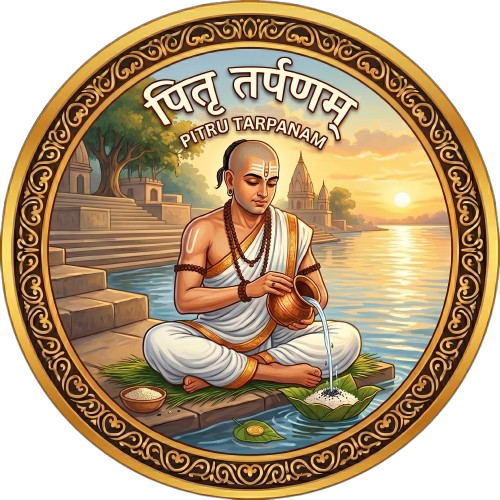
The heart of the rite is tarpanam—water mixed with black til, offered with the hands to the departed while their names and gotram are recited. Simple and very old.
Depending on the tradition and the day, the fuller observance may include pinda pradanam, the offering of rice pindas, and anna daanam, feeding others in the ancestors' name. Feeding a brahmana, or the poor, or a cow, or a crow—the crow because it is held to carry offerings to the departed—is part of the day in almost every regional custom.
The rites are performed in aparahna kaalam, the afternoon window of roughly 1:00 pm to 3:30 pm. One thing families abroad often get wrong: this is the aparahna where you are, not IST. Your priest will calculate the correct window for your location.
The karta observes a fast until the rites are complete, wears traditional dress, and performs the offering facing south, the direction of the ancestors.
Beyond the mechanics, there is a simpler instruction that every tradition agrees on. Do it with attention. Say the names aloud. Whatever else is uncertain, sincerity is not optional.
Which day is my day? The question most families ask
Shraddham is performed on the tithi on which the person died—not the English calendar date.
If your father passed away on Bahula Saptami, you observe Saptami, whichever date that falls on this year. The English date of his passing is not the marker.Most families do not know the tithi. That is completely normal, and there are two ordinary answers.
- If the tithi is not known, observe on Mahalaya Amavasya — Saturday, October 10. This final day is kept for all ancestors together, known and unknown, named and unnamed. It is valid for everyone, and it is the reason the day exists.
- If you want the exact tithi, a purohit can work it backward from the date of death against the panchangam of that year. You need the date, and ideally, the place. It takes very little time.
Send us the date and we will have a pandit work out the tithi for you. WhatsApp +91 9063082668 or write to support@vedicblessing.com.
What is the difference between Mahalaya Paksham and the annual taddinam?
These are two different observances, and they do not replace each other.
- The annual taddinam, also called abdikam, is for one named person on their tithi, every year.
- Mahalaya Paksham is for the ancestors collectively, once a year, in this fortnight. It includes those whose tithi you know and those you do not.
Families who keep both do both. The annual rite remembers a person. The fortnight remembers a lineage.
How do families living abroad perform shraddham?
This is the question that brings most people to this page, and the honest answer is that it is difficult—not because the rite cannot be done, but because of what usually stands in the way.
There is no purohit nearby. There is no one in the house who knows the sequence. The sankalpam needs a gotram and a pravara that nobody remembers exactly. The tithi is unknown. The aparahna window falls in the middle of a working day. And beneath all of it sits the feeling that doing it imperfectly might be worse than not doing it at all.
None of these is a reason to let the fortnight pass.
Go back to what the rite actually requires. The karta is you. The offering comes from your hands. What you are missing is not authority — you already have that, by being of that line. What you are missing is guidance: the correct mantras, the correct sequence, the sankalpam said properly with your gotram and your ancestors' names.
That is precisely what a priest provides, and it is the one part of this that distance cannot take away from you.
Shraddham with live priest guidance
At VedicBlessing, our pandits guide shraddham and tarpanam live over video call for families anywhere in the world.
You perform the rite. The pandit guides you through every step — the sankalpam with your gotram and your ancestors' names, the tarpanam, the correct sequence, and the correct pronunciation. He calculates the aparahna window for your city, not for India.
We have pandits who specialize in ancestral rites. This is not a general booking handed to whoever is free. Shraddham has its own discipline, and it is given to priests who know it.
Before the session you receive a written list of what to arrange — water, black til, darbha and the rest — all of it available locally. We do not ship items, and nothing on the list is difficult to find.
If you do not know your tithi, tell us the date of passing, and we will have it worked out before your session.
Book Shraddham with Live Priest Guidance →
📧 support@vedicblessing.com · 📱 WhatsApp +91 9063082668
What happens after Mahalaya Amavasya?
On the evening of October 10 the ancestors are said to return to Pitru Loka, remembered and released. And the very next morning, Sharada Navaratri begins.
The order is not accidental. The old ones are honoured first, and only then does the Goddess arrive. The house is put right with its past before it turns toward the year ahead.
That is the quiet reassurance inside this fortnight. It is not really about loss. It is about a line that continues — from the ones who came before, through you, to the ones who come after. Sixteen days a year to turn around and say their names, and then life goes on forward again.
Whatever your circumstances this year, and wherever you are, that much can be done.