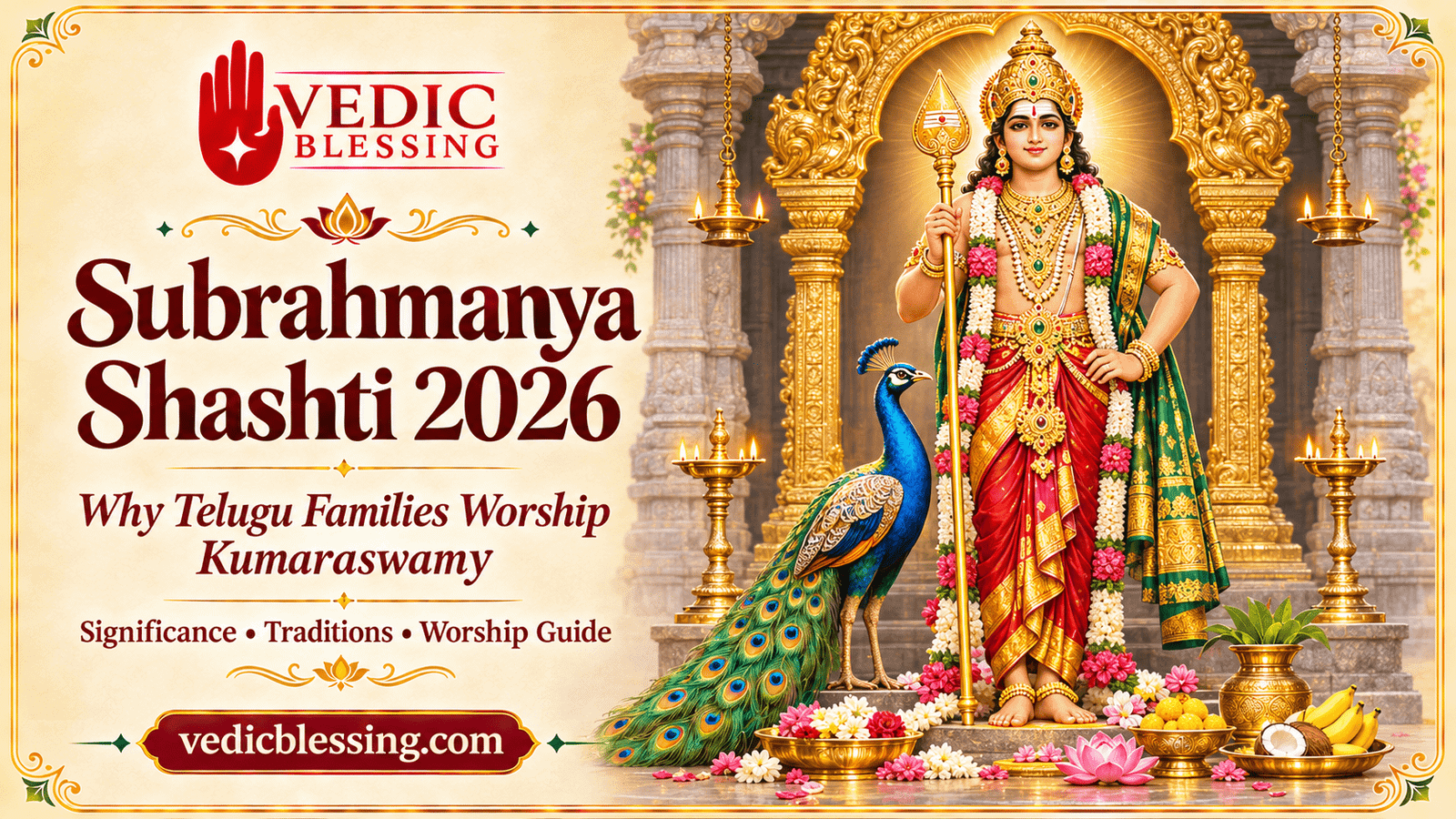
Subrahmanya Shashti 2026: Why Telugu Families Worship Kumaraswamy on 15 December, and How
Six days into Margasira comes a day that Telugu and Kannada families keep with particular care: Subrahmanya Shashti, Tuesday 15 December 2026. At Mopidevi the queues start before dawn. In Secunderabad, Skandagiri runs Rudrabhishekam and homam from early morning. In villages, women carry milk to the anthill. And in NRI homes, someone phones a parent to ask what exactly to do. This post answers that, with the story behind the day, the reason Subrahmanya is worshipped in the form of a serpent, the home procedure, and the dates for India and abroad.
When is Subrahmanya Shashti 2026?
India: Tuesday 15 December 2026. Shashti tithi begins at 7:16 PM on Monday 14 December and ends at 9:19 PM on Tuesday 15 December (IST). Since the tithi is present at sunrise on Tuesday, that is the day of observance.
USA, Canada, UK, Gulf: In most cities abroad the Shashti tithi falls across Monday 14 December in local time. Families there observe it on Monday evening or Tuesday morning; ask us for your city if unsure.
Australia, Singapore: Tuesday 15 December.
Subrahmanya Shashti is also called Subbaraya Shashti, Kumara Shashti, Skanda Shashti and, in Maharashtra, Champa Shashti.
Who is Subrahmanya?
Subrahmanya is the son of Shiva and Parvati, the elder brother of Ganapathi in the Telugu and Kannada tradition, and the commander of the devas. He is Kumaraswamy, the eternal youth; Shanmukha, the six-faced; Karthikeya, raised by the six Krittika stars; Skanda; Saravanabhava, born in the reed forest; Murugan in Tamil; and simply Subbarayudu in many Telugu homes. His weapon is the vel, his mount the peacock, and his flag carries the rooster.
What is the story behind Subrahmanya Shashti?
The asura Tarakasura had won a boon from Brahma that only a son of Shiva could kill him, and Shiva, after Sati's death, had withdrawn into meditation with no thought of a son. Tarakasura took heaven. The devas went to Shiva. Through Parvati's penance and Shiva's grace, six sparks of Shiva's fire were carried by Agni and Ganga to the Saravana reed forest, where six infants were born and nursed by the six Krittika maidens. Parvati gathered the six into one child with six faces, Shanmukha. On the sixth day, the Shashti, the devas made him their commander, and he slew Tarakasura with the vel his mother gave him.
The Shukla Shashti of Margasira is kept as the day of that victory and of Subrahmanya's installation as Devasenapati. Tamil tradition keeps a separate Skanda Shashti in the month of Aippasi, with the Soorasamharam at Tiruchendur; the Telugu and Kannada Subrahmanya Shashti is this Margasira day.
Why is Subrahmanya worshipped as a serpent?
This is the question people ask most, and the one a Telugu post has to answer properly.
Subrahmanya and the Nagas are not the same deity, but in Andhra and Karnataka Subrahmanya is worshipped in Naga form. At Mopidevi in Krishna district the deity is a Naga; at Kukke Subrahmanya in Karnataka, Subrahmanya is enshrined with Vasuki and Shesha; at Ghati Subrahmanya near Bengaluru, the idol is Subrahmanya in front and Narasimha behind, with serpents around. The tradition holds that after the war the serpent kings sought Subrahmanya's refuge and he gave them his protection, so that worship of the Naga reaches him and his grace reaches the Naga devotee. This is why the same day in Karnataka is kept as a Naga worship day, why milk is poured into the anthill on Subrahmanya Shashti as on Nagula Chavithi, and why astrologers send people with Rahu-Ketu, Sarpa or Kuja dosha to Subrahmanya temples. Mopidevi's main service is the Rahu Ketu Sarpa Dosha Nivarana pooja.
Kuja, Mars, is also his planet. Subrahmanya is Kumara, and Kuja is Kumara in the planetary order; red is both their colour. That is why Tuesday, Mangalavaram, is his day, and why 15 December 2026, a Tuesday Shashti, is a particularly good one.
What do people pray for on this day?
Children. Couples waiting for a child make the Subrahmanya vratam and pour milk at the anthill; it is the oldest reason for the day.
Marriage. Where a horoscope shows Kuja dosha or Naga dosha and a wedding is delayed, Subrahmanya is the remedy deity.
Protection from Rahu-Ketu and Sarpa dosha. With Rahu and Ketu changing signs on 5 December this year, many families will keep this Shashti with that in mind.
Courage and clear thinking. He is the commander; students and anyone facing a fight pray to him.
How do you observe Subrahmanya Shashti at home?
The day before, Panchami: Many families begin on Panchami, with a simple Naga worship, milk at the anthill or at a Naga stone, and a lamp. Both days together are the traditional observance.
Shashti morning: Bathe, clean the pooja room, draw a muggu. Place a picture or small idol of Subrahmanya on a peetham; if you have none, a Naga pratima or a silver Naga serves, as the tradition itself does.
Sankalpam: With your gotra and the names of the family, and the specific prayer, for a child, for a marriage, for relief from a dosha, or simply for well-being.
Abhishekam: Water, then milk, then water again. Milk is the essential offering; at temples it is the first thing poured.
Alankaram: Red flowers, especially red hibiscus and oleander; sandal paste; a red cloth if you have one.
Archana: Subrahmanya Ashtottaram, 108 names. If you cannot, chant "Om Saravanabhavaya Namah" 108 times, or the six-letter mantra "Sharavanabhava" itself.
Stotram: Subrahmanya Bhujangam, or the shorter Subrahmanya Ashtakam. Reading even one is enough.
Naivedyam: Pongali or payasam, bananas, and a laddu; in many homes, pulihora. No onion or garlic in the house that day.
Putta lo paalu: If there is an anthill nearby, take milk, turmeric, kumkum, and flowers, pour the milk gently at the mouth of the anthill, and offer the rest. Do not disturb the anthill; do not try to see the serpent.
Fast: Most people take one meal after the pooja and avoid rice at night. Those who keep the full vratam fast till the evening pooja.
Evening: A lamp before Subrahmanya and, if possible, a visit to a Subrahmanya temple. In Hyderabad, Skandagiri in Secunderabad; in Andhra, Mopidevi; in Bengaluru, Ghati; in Karnataka, Kukke.
How do you observe it abroad?
Date: Check your city; for most of North America it is Monday 14 December. The pooja can be done that evening.
No anthill: Offer the milk to a Naga image or picture, and pour it later at the base of a tree. The intent is the offering.
No Subrahmanya idol: A picture on a phone or print, or a small silver Naga from an Indian store. The Kukke tradition worships him as Naga; you are on firm ground.
Temple: Most Murugan temples abroad are Tamil and will have a special pooja; the Telugu Shashti and the Tamil monthly Shashti coincide this month, so go.
With children: Tell them the six-faced child who became the commander. It is the one story that makes a small boy sit still.
What else is happening around this date?
Rahu-Ketu transit: Saturday 5 December 2026. Families doing a shanti for the transit often complete it with Subrahmanya worship on this Shashti.
Margasira Lakshmivaram: Thursdays 10 and 17 December fall either side of it.
Dhanurmasam begins: Wednesday 16 December, the day after.
Frequently Asked Questions
When is Subrahmanya Shashti in 2026?
Tuesday 15 December 2026 in India. The Shashti tithi runs from 7:16 PM on 14 December to 9:19 PM on 15 December IST. In most of the USA and Canada it falls on Monday 14 December local time.
Is Subrahmanya Shashti the same as Skanda Shashti?
Same deity, different days. The Tamil Skanda Shashti with the Soorasamharam falls in Aippasi, which was 14 to 15 November this year. The Telugu and Kannada Subrahmanya Shashti is Margasira Shukla Shashti, 15 December.
Why is milk poured into the anthill on Subrahmanya Shashti?
Because in Andhra and Karnataka Subrahmanya is worshipped in Naga form, and the anthill is the Naga's home. The offering reaches both.
Can Subrahmanya Shashti pooja help with delayed marriage?
It is the traditional remedy for Kuja dosha and Naga dosha, the two most often cited for delay. Ask a pandit to read the horoscope first; then the pooja, with a specific sankalpam, is the right step.
Is this pooja good for Rahu-Ketu dosha?
Yes. Mopidevi's principal service is the Rahu Ketu Sarpa Dosha Nivarana pooja, and this Shashti, ten days after the 5 December transit, is a natural day for it.
What is the naivedyam for Subrahmanya Shashti?
Pongali or payasam, bananas and laddu are the common offerings; pulihora in many homes. Milk is the essential abhishekam.
Can I do the pooja without an idol?
Yes. A picture, or a silver Naga, is enough; the Naga form is how he is worshipped at Mopidevi and Kukke.
What if I cannot fast?
Take one simple meal after the pooja. Elders, children, pregnant women and anyone unwell should not fast.
Which temples are famous for Subrahmanya Shashti in the Telugu states?
Mopidevi in Krishna district, Skandagiri in Secunderabad, and Biccavolu in East Godavari; in Karnataka, Kukke Subrahmanya and Ghati Subrahmanya.
Should I do Naga pooja on Panchami or Shashti?
Traditionally both: Naga worship on Panchami, Subrahmanya worship on Shashti. If you can do only one day, do Shashti.
Keep This Shashti With Us
If there is a prayer behind this day for your family, a child, a marriage, a horoscope that needs quieting after the Rahu-Ketu transit, our pandits can perform the Subrahmanya Shashti pooja live for you on 15 December, in your name and gotra, with abhishekam, Ashtottaram, Bhujangam and the sankalpam for your specific prayer, while you sit before your own pooja shelf. Panchami Naga pooja can be added the day before.
Book at vedicblessing.com. WhatsApp +91 9063082668. Email support@vedicblessing.com.
Observe this with a live puja
Our pandits perform pujas live on video in your name and gotra. You can also check today's Panchang and auspicious dates for your city.