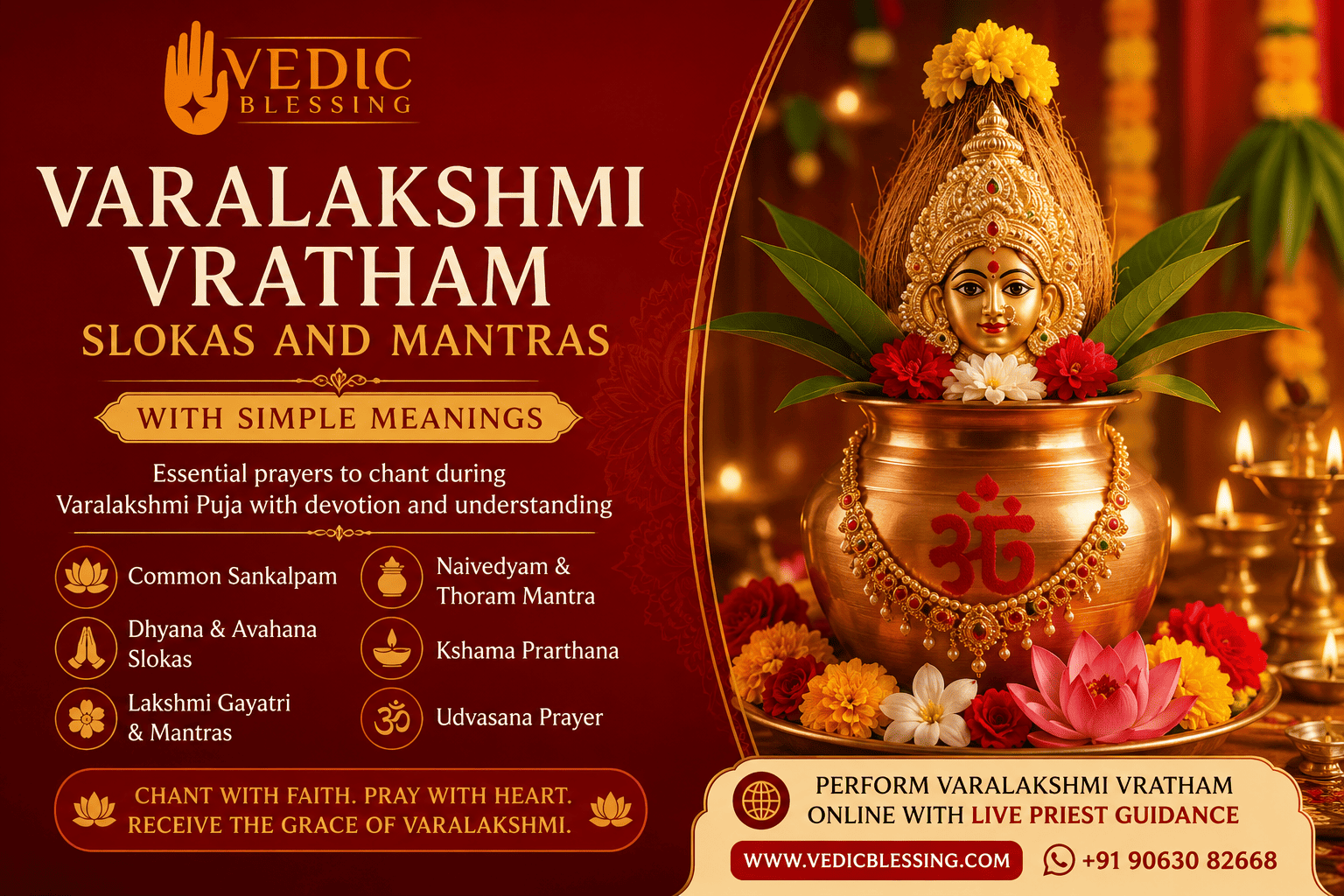
Varalakshmi Vratham Slokas and Mantras with Simple Meanings
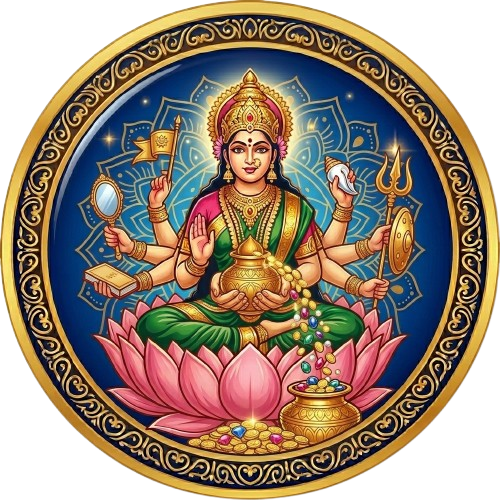
Varalakshmi Vratham is a sacred expression of gratitude to Goddess Mahalakshmi, the divine source of health, harmony, courage, knowledge, abundance and auspiciousness.
Beautiful decorations, traditional offerings and the sacred kalasham make the occasion special. However, the true heart of the Vratham lies in the Sankalpam and the sincere chanting of mantras.
Each prayer has a purpose. Some prepare the mind, some invoke Goddess Varalakshmi, while others express gratitude, surrender and devotion.
Here are the essential Varalakshmi Vratham slokas and mantras with simple meanings, arranged in the order they may be chanted during the puja.
SIMPLE CHANTING ORDER
Devotees performing a simple Varalakshmi Puja may follow this sequence:
- Ganapati Prayer
- Varalakshmi Sankalpam
- Varalakshmi Dhyana Slokas
- Avahana Mantra
- Shodashopachara Puja
- Om Sri Varalakshmyai Namah
- Lakshmi Gayatri Mantra
- Mahalakshmi Ashtakam
- Naivedyam Prayer
- Thoram Mantra
- Varalakshmi Namaskara Prayer
- Kshama Prarthana
- Udvasana or Punar Puja Prayer
The exact order may vary according to regional customs, family sampradaya and priestly guidance.
GANAPATI PRAYER
Begin the Vratham by praying to Lord Ganesha for the peaceful completion of the puja.
Shuklambaradharam Vishnum
Shashivarnam Chaturbhujam
Prasanna Vadanam Dhyayet
Sarva Vighnopashantaye
Meaning:
We meditate upon the divine Lord who is dressed in white, radiant like the moon, four-armed and pleasant-faced.
May all obstacles be removed, and may the worship proceed peacefully.
COMMON VARALAKSHMI VRATHAM SANKALPAM
Sankalpam is the sacred declaration of the devotee’s intention.
Hold a few akshatas and a flower in your right palm while reciting the prayer.
Purvokta Evam Guna Visheshana Vishishtayam
Shubha Tithau
Asmakam Saha Kutumbanam
Kshema Sthairya Vijaya
Ayur Arogya Aishwarya Abhivriddhyartham
Dharma Artha Kama Moksha
Chaturvidha Purushartha Phala Siddhyartham
Sat Santana Saubhagya Phalavaptyartham
Sri Varalakshmi Devatam Uddishya
Sri Varalakshmi Devata Prityartham
Kalpokta Vidhanena Yavachchhakti
Dhyanavahanadi Shodashopachara Pujam Karishye
Meaning:
On this auspicious day, we perform Sri Varalakshmi Puja for the well-being, stability, success, long life, good health and prosperity of our family.
May we be guided toward Dharma, Artha, Kama and Moksha. May our family receive happiness, auspiciousness and the compassionate grace of Goddess Varalakshmi.
According to our ability and tradition, we now begin the worship of Goddess Varalakshmi through meditation, invocation and sacred offerings.
Note:
A complete traditional Sankalpam may also include the date, location, gotram, names, nakshatra and Panchang details. The exact wording may vary according to family tradition and priestly guidance.
SIMPLE SANKALPAM IN ENGLISH
Devotees who cannot recite the Sanskrit Sankalpam may prayerfully say:
“On this auspicious day, I perform Sri Varalakshmi Vratham with devotion for the health, protection, peace, harmony, spiritual growth and prosperity of my family. May Goddess Varalakshmi accept this worship and bless our family and all beings with well-being and auspiciousness.”
VARALAKSHMI DHYANA SLOKA
Dhyanam means meditating upon the divine form of Goddess Varalakshmi.
Padmasane Padmakare
Sarvalokaika Pujite
Narayana Priye Devi
Suprita Bhava Sarvada
Meaning:
O Goddess seated upon a lotus and holding the sacred lotus, you are worshipped throughout all worlds.
O beloved Goddess of Lord Narayana, please remain pleased with us always.
SECOND VARALAKSHMI DHYANA SLOKA
Ksheerodarnava Sambhute
Kamale Kamalalaye
Susthira Bhava Me Gehe
Surasura Namaskrite
Meaning:
O Goddess who arose from the ocean of milk, O lotus Goddess who resides in the lotus, you are worshipped by divine and celestial beings.
Please remain firmly present in our home and bless our family.
VARALAKSHMI AVAHANA MANTRA
Avahanam is the respectful invocation of Goddess Varalakshmi into the sacred kalasham or image.
Sarvamangala Mangalye
Vishnu Vakshah Sthalalaye
Avahayami Devi Tvam
Suprita Bhava Sarvada
Sri Varalakshmi Devatayai Namah
Avahayami
Meaning:
O most auspicious Goddess who resides upon the heart of Lord Vishnu, we respectfully invoke your divine presence.
Please accept our worship and remain pleased with us always.
After respectfully invoking Goddess Varalakshmi through Avahanam, devotees may proceed with Shodashopachara Puja, the traditional sixteen-step worship offered to the Goddess with devotion and reverence. For the complete sequence, required offerings, and simple step-by-step guidance, please refer to our detailed guide: Perform Shodashopachara Puja for Varalakshmi Vratham.
You can hyperlink the words “Perform Shodashopachara Puja for Varalakshmi Vratham.”
SIMPLE VARALAKSHMI MANTRA
Om Sri Varalakshmyai Namah
Meaning:
I bow with devotion to Goddess Sri Varalakshmi.
This simple nama mantra may be chanted 11, 21, 54 or 108 times.
Offer one flower, petal or a small quantity of akshatas with every repetition. This is especially suitable for beginners who may not be able to perform an elaborate archana.
MAHALAKSHMI MANTRA
Om Shreem Mahalakshmyai Namah
Meaning:
I bow to Goddess Mahalakshmi, the divine source of abundance, harmony, auspiciousness and spiritual fulfilment.
“Shreem” is traditionally associated with the sacred energy of Goddess Lakshmi.
This mantra may be chanted quietly during meditation or after the main archana.
LAKSHMI GAYATRI MANTRA
Om Mahalakshmyai Cha Vidmahe
Vishnupatnyai Cha Dhimahi
Tanno Lakshmih Prachodayat
Meaning:
We seek to understand the divine presence of Mahalakshmi.
We meditate upon the beloved consort of Lord Vishnu.
May Goddess Lakshmi illuminate, inspire and guide our minds.
Beginners may chant this mantra 3, 9 or 11 times.
A BEAUTIFUL VERSE FROM SRI MAHALAKSHMI ASHTAKAM
Namastestu Mahamaye
Sri Pithe Surapujite
Shankha Chakra Gada Haste
Mahalakshmi Namostute
Meaning:
Salutations to Mahalakshmi, the great divine power who is worshipped by the devas and seated upon the sacred throne of prosperity.
O Goddess who holds the conch, discus and mace, we bow to you.
The complete Sri Mahalakshmi Ashtakam contains eight verses praising the Goddess as the giver of wisdom, protection, abundance and spiritual liberation. It may be chanted after Lakshmi Archana.
NAIVEDYAM PRAYER
Chant this prayer while offering fruits, sweets and prepared food to Goddess Varalakshmi.
Naivedyam Shadrasopetam
Dadhi Madhvajya Samyutam
Nana Bhakshya Phalopetam
Grihana Harivallabhe
Meaning:
O beloved Goddess of Lord Hari, please accept this food prepared with different tastes, fruits and devotional offerings.
May this naivedyam be accepted as an expression of our gratitude and love.
VARALAKSHMI THORAM MANTRA
The sacred Varalakshmi thoram traditionally contains nine knots and is worshipped before being tied.
Badhnami Dakshine Haste
Nava Sutram Shubhapradam
Putra Pautrabhivriddhim Cha
Saubhagyam Dehi Me Rame
Meaning:
I tie this auspicious nine-thread sacred band upon the right hand.
O Goddess Lakshmi, please bless our family with well-being, continuity, prosperity and lasting auspiciousness.
VARALAKSHMI NAMASKARA PRAYER
Namaste Lokajanani
Namaste Vishnuvallabhe
Pahi Mam Bhaktavarade
Varalakshmi Namo Namah
Meaning:
Salutations to you, O Mother of the universe.
Salutations to you, O beloved Goddess of Lord Vishnu.
O Varalakshmi, giver of blessings to devotees, please protect us.
We bow to you again and again.
KSHAMA PRARTHANA
Conclude the main worship by asking Goddess Varalakshmi to forgive any mistakes made knowingly or unknowingly.
Mantra Hinam Kriya Hinam
Bhakti Hinam Maheshwari
Yat Pujitam Maya Devi
Paripurnam Tadastu Te
Meaning:
O Divine Mother, this worship may have been incomplete in mantra, action or devotion.
Please accept it compassionately and make it complete through your divine grace.
UDVASANA OR PUNAR PUJA PRAYER
Udvasana is the respectful conclusion of the worship.
It is different from Udyapana. Udyapana generally refers to the formal completion of a Vratham observed over a prescribed period. Udvasana is the prayerful conclusion in which the invoked divine presence is respectfully requested to return to its sacred abode while continuing to bless the family.
In many traditions, Udvasana is performed during Punar Puja on the following day.
Yantu Deva Ganah Sarve
Pujam Adaya Matkritam
Ishta Kamyartha Siddhyartham
Punaragamanaya Cha
Meaning:
May all divine beings graciously accept the worship performed by us.
May our sincere and righteous prayers be fulfilled, and may the divine presence return again on the next auspicious occasion.
KALASHA UDVASANA PRAYER
Asmat Kumbhat Sri Varalakshmi Devatam
Yathasthanam Pratishthapayami
Shobhanarthe Kshemaya
Punaragamanaya Cha
Meaning:
From this sacred kalasham, we respectfully return the invoked presence of Goddess Sri Varalakshmi to her divine abode.
May she continue to bless our home with auspiciousness and well-being, and may she graciously return again.
The timing and procedure for Kalasha Udvasana may differ according to family sampradaya. Follow the guidance of your family priest where applicable.
FREQUENTLY ASKED QUESTIONS
1. What is the main mantra for Varalakshmi Vratham?
A simple and meaningful mantra is:
Om Sri Varalakshmyai Namah
It may be chanted while offering flowers, petals or akshatas.
2. How many times should the Varalakshmi mantra be chanted?
It may be chanted 11, 21, 54 or 108 times, depending on the time available and family tradition.
3. Can the Sankalpam be said in English?
Yes. Devotees who cannot recite the Sanskrit Sankalpam may state their prayer intention sincerely in their preferred language.
4. Is perfect Sanskrit pronunciation compulsory?
Sanskrit should be chanted slowly and respectfully. Beginners need not avoid prayer because of fear of mistakes. Longer Vedic mantras are best learned under qualified guidance.
5. Should Lakshmi Ashtottara be chanted during the Vratham?
Lakshmi Ashtottara Shatanamavali may be recited while offering a flower, kumkum or akshatas with each of the 108 sacred names.
6. Can Sri Suktam be chanted?
Yes. Sri Suktam is a revered Vedic hymn used during Lakshmi worship. Since correct pronunciation and svara are important, it is best learned or chanted under the guidance of a qualified priest.
7. What should I do if I make a mistake during the puja?
Continue the worship calmly and sincerely. At the conclusion, chant the Kshama Prarthana and ask Goddess Varalakshmi to accept the puja compassionately.
8. Is Udvasana performed on the same day?
This varies by family tradition. Some families conclude the main worship on the same day, while others perform Kalasha Udvasana during Punar Puja on the following day.
9. Is Udvasana the same as Udyapana?
No. Udvasana is the respectful conclusion of the invoked divine presence after the puja. Udyapana generally refers to the formal completion of a Vratham observed over a prescribed period or number of occasions.
PERFORM VARALAKSHMI VRATHAM WITH LIVE PRIEST GUIDANCE
Celebrate Varalakshmi Vratham at home with devotion, clarity and traditional guidance.
Through VedicBlessing, an experienced Vedic priest connects with your family live through video call and guides you through Sankalpam, Kalasha Puja, mantras, Lakshmi Archana, Vratha Katha, thoram, naivedyam, Harathi and concluding prayers.
You perform every sacred step at home while the priest chants and guides you according to your preferred language, time zone and family sampradaya.
Book your guided online Varalakshmi Vratham at VedicBlessing.com.
WhatsApp: +91 90630 82668
CONCLUSION
The power of a mantra is experienced most deeply when it is chanted with attention, understanding and devotion.
Whether your Varalakshmi Puja is elaborate or simple, let every flower carry gratitude, every mantra carry faith and every prayer carry a sincere wish for the well-being of all.
May Goddess Sri Varalakshmi bless every home with health, harmony, courage, abundance and lasting auspiciousness.
Om Sri Varalakshmyai Namah.