Rahu-Ketu Transit 2026: What to Do, Poojas and Mantras
"Okay, the transit is coming. Now what?"
Since we published our first guide on the Rahu-Ketu transit, one question has filled our inbox more than any other. It is not "when is it?" or "which rashi is affected?". It is this: "What should I actually do about it?"
It is a fair question. Most articles on Rahu and Ketu leave you with a date, a list of rashis and a vague sense of worry. Very few tell you what to do on Monday morning.
This guide does. You will learn how to check if the transit matters for you, which pooja suits which situation, which mantras to chant and how often, and what to avoid for the next 18 months. No fear, no jargon, only steps you can follow from your home anywhere in the world.
A 60-second recap of the transit
On December 5, 2026 (India time), Rahu moves from Kumbha (Aquarius) into Makara (Capricorn), and Ketu moves from Simha (Leo) into Karka (Cancer). They stay there for about 18 months.
A few facts make the rest of this guide easier to follow.
- Rahu and Ketu are not physical planets. They are the two points where the Moon's path crosses the Sun's path. Eclipses happen near these points, which is why our tradition calls them chhaya grahas, the shadow planets.
- They always move together and always sit opposite each other. When one changes sign, the other changes too.
- They move backwards through the zodiac, unlike the other grahas.
- Rahu amplifies. It is linked with ambition, desire, foreign lands, technology and sudden change.
- Ketu detaches. It is linked with letting go, intuition, spirituality and moksha.
So a Rahu-Ketu transit is best seen as a shift in focus. One area of life gets louder and another gets quieter. Which areas depends on your own chart.
New to the topic? Read our first post, https://www.vedicblessing.com/blog/rahu-ketu-transit-2026-when-it-happens-which-rashis-are-affected-and-simple-vedic-remedies-for-a-blessed-year-ahead Rahu-Ketu Transit 2026: When It Happens, Which Rashis Are Affected, and then come back here.
Dates in this post follow India time. In the US and Canada the transit moment can fall on the previous calendar day. Ask us for the timing in your city.
Step 1: Find out if it really affects you
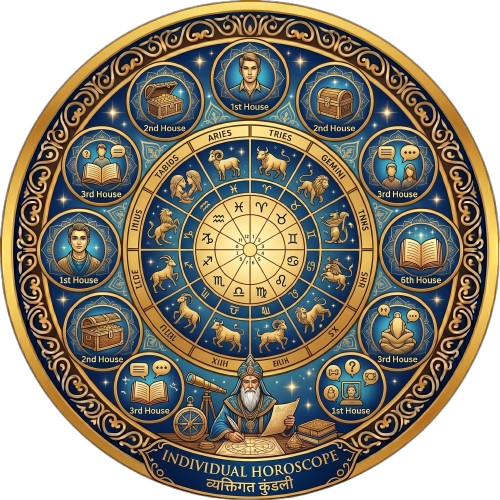
Not everyone needs a remedy. Before you plan any pooja, check three things in your Janma Kundali.
1. Your Moon sign (Janma Rashi). Count from your rashi to where Rahu and Ketu will sit. Tradition treats the 3rd, 6th and 11th positions as supportive.
| Your Janma Rashi | What the transit traditionally indicates |
|---|---|
| Makara, Karka | Rahu or Ketu passes over your Moon. The most personal transit. A remedy is usually advised. |
| Mithuna, Dhanu. | Rahu or Ketu in the 8th from your Moon. Go slow on risk, health routines and big money moves. |
| Kumbha, Simha | Rahu or Ketu in the 12th. Watch expenses, sleep and travel plans. |
| Vrischika, Simha, Meena | Rahu in the 3rd, 6th or 11th. Often good for courage, competition and gains. |
| Vrishabha,Kumba,Kanya | Ketu in the 3rd, 6th or 11th. Often good for focus and overcoming obstacles. |
| Mesha, Tula | Rahu and Ketu on the 10th and 4th axis. Career and home both ask for attention. |
Simha and Kumbha appear twice because one node helps while the other asks for care. That mixed picture is normal.
2. Your current dasha. If you are running a Rahu or Ketu Mahadasha or Antardasha, the transit is felt much more strongly, whatever your rashi.
3. Planets in Makara or Karka in your birth chart. If your Lagna, Sun, Moon or another key planet sits in either sign, the transit touches it directly.
If none of the three apply, simple daily prayer is enough. If two or three apply, a proper remedy is worth planning. Not sure how to read your chart? This is exactly what an astrology consultation is for.
Step 2: Choose the right pooja
There is no single "Rahu-Ketu pooja" that fits everyone. Match the pooja to your situation.
| Pooja | Best suited for | Why it is chosen |
|---|---|---|
| Rahu-KetuShanti Puja | Makara and Karka rashi, or anyone in Rahu or Ketu dasha | Addresses both nodes directly through japa and offerings |
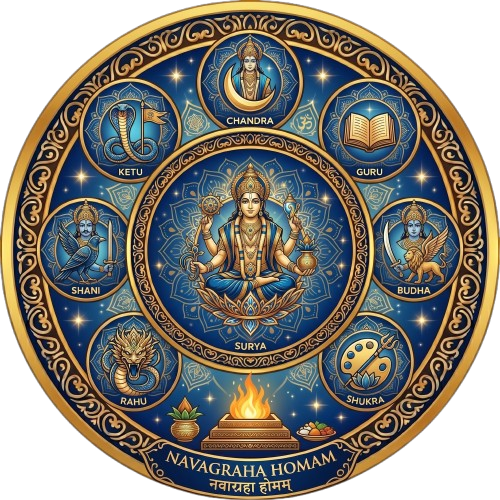
| Navagraha Puja/Homam | Families who want one pooja covering everyone at home
| Brings all nine grahas into balance, not only the nodes |
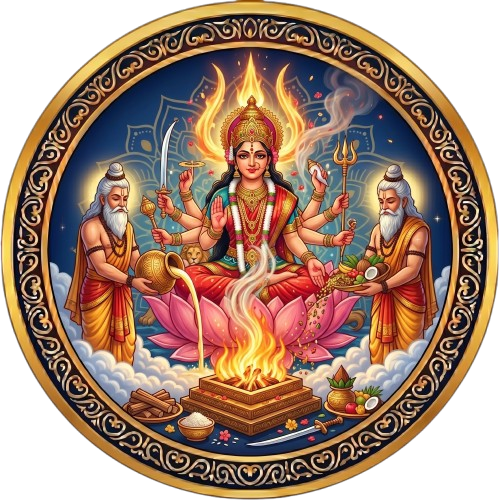
| Durga Puja | Rahu-related worries such as anxiety, confusion, sudden obstacles
| Durga Devi is the deity traditionally worshipped for Rahu |
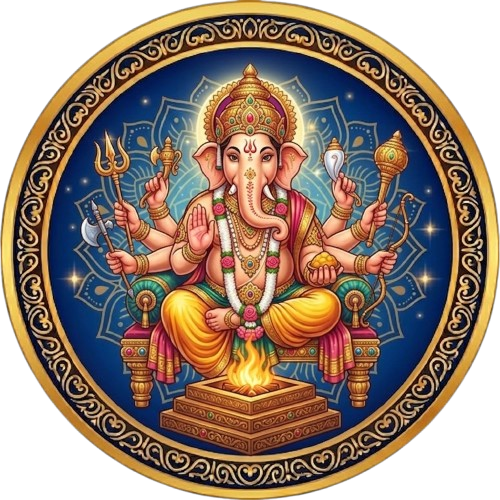
| Ganapathi Puja/Homam | Ketu-related worries such as lack of direction, delays, detachment
| Lord Ganesha is the deity traditionally worshipped for Ketu |
| Subrahmanya/Naga Puja | Sarpa Dosha or Kaal Sarp Dosha in the chart
| Naga devatas and Lord Subrahmanya are worshipped for serpent-related doshas |
The best days. Saturday is preferred for Rahu and Tuesday for Ketu. Many South Indian families also worship Durga Devi during Rahu Kalam on Tuesdays and Fridays. The days around the transit date and Amavasya are considered especially suitable.
How it works with VedicBlessing. You are the yajamana, the one who performs the pooja. A pandit joins you live and guides you through every step, from sankalpa in your name, nakshatra and gotra to the final harathi. We send you a full samagri list with your order confirmation so you can arrange the items locally.
Short on time? A Blessing Service is a 10-minute live session in which the pandit chants Vedic mantras in your name, nakshatra and gotra. No preparation is needed.
Step 3: Chant the right mantra
Mantra japa is the simplest remedy of all. It costs nothing and you can start today.
| Rahu | Ketu | |
|---|---|---|
| Beeja mantra | Om Bhram Bhreem Bhroum Sah Rahave Namaha | Om Sram Sreem Sroum Sah Ketave Namaha |
| Simple mantra | Om Rahave Namaha | Om Ketave Namaha |
| Deity to pray to | Durga Devi | Lord Ganesha |
| Preferred day | Saturday | Tuesday |
| Traditional japa count | 18,000 | 7,000 |
| Daily practice | 108 times | 108 times |
| Grain to donate | Black gram (minumulu) | Horse gram (ulavalu) |
How to make it a habit
- Pick a fixed time, ideally after your bath in the morning or at dusk.
- Light a lamp and sit facing east or north.
- Use a japa mala so you can count 108 without distraction.
- Start on a Saturday for Rahu or a Tuesday for Ketu, and continue for at least 40 days.
- If the beeja mantra feels hard to pronounce, use the simple mantra. Sincerity matters more than speed.
No time for a separate japa? Reciting the Navagraha Stotram, Durga Stuti or Ganesha Dwadasa Nama Stotram once a day is a good alternative for the whole family.
Step 4: Do's and don'ts for the next 18 months
Rahu rewards discipline and punishes shortcuts. Ketu rewards simplicity and punishes ego. Keep that in mind and most of this list becomes common sense.
| Do | Don't |
|---|---|
| Keep a steady daily prayer routine, even five minutes. | Panic or make fearful decisions because of something you read online |
| Read every contract, loan and investment document carefully. | Chase get-rich-quick schemes or speculative bets |
| Double check visa, immigration and travel paperwork. | Leave official deadlines to the last minute |
| Respect and serve parents, elders and ancestors. | Neglect Pitru karyas such as Amavasya tarpanam |
| Donate food or grains on Saturdays and Tuesdays | Wear Gomed (hessonite) or Cat's Eye without a chart-based recommendation |
| Spend time in meditation, temple visits or seva. | Get pulled into gossip, arguments or workplace politics |
| Look after sleep, diet and regular health checkups | Depend on alcohol or other habits to handle stress |
| Ask an astrologer before a major move such as job change or house purchase | Assume the transit is bad for you without checking your chart |
One more point for parents. Children pick up our anxiety quickly. Talk about the transit at home as a time for extra prayer, not as a time of danger.
Five myths you can stop worrying about
Myth 1: Rahu and Ketu always bring bad results. Rahu has given many people foreign opportunities, career jumps and success in technology. Ketu has given deep focus and spiritual growth. The result depends on placement, not on the name of the graha.
Myth 2: The transit affects everyone of the same rashi in the same way. Your rashi is only one of three checks. Dasha and birth chart placements change the picture completely. Two people of Makara rashi can have very different years.
Myth 3: Everything changes on December 5. A transit is a gradual shift over 18 months, not a switch. Results unfold slowly, and they are felt most when the nodes pass over sensitive points in your chart.
Myth 4: One expensive pooja cancels the transit. No remedy removes a transit. A pooja or japa is a way to seek grace, steady the mind and act wisely. Regular simple practice is worth more than one grand ritual.
Myth 5: Everyone has Kaal Sarp Dosha during this period. Kaal Sarp Dosha is a birth chart condition, where all planets fall between Rahu and Ketu. A transit does not create it. Only a chart reading can confirm it.
If you live outside India
Back home, many families would visit a temple known for Rahu-Ketu worship, such as Srikalahasti, during this period. From the US, UK, Canada, Australia, Singapore or the UAE, that is rarely possible. Here is what works instead.
- Your home is a valid place for the pooja. A sankalpa taken with your name, gotra, nakshatra and current city is complete in itself.
- Use your local timings. Rahu Kalam, tithi and muhurtham change with your city. Check them on our free Panchang and Muhurat Finder before you fix a time.
- Samagri is easier than you think. Black gram, horse gram, flowers, fruits, ghee and lamps are available at most Indian grocery stores abroad. We send the full list in advance.
- Weekends work. If a weekday Saturday or Tuesday muhurtham is not possible, our team will suggest the next suitable slot in your time zone.
- You can sponsor it for family in India too. Parents or siblings back home who are going through a Rahu or Ketu dasha can have the pooja done in their name.
Frequently asked questions
When is the Rahu-Ketu transit in 2026?
December 5, 2026, India time. Rahu enters Makara and Ketu enters Karka for about 18 months.
Which rashis should be most careful?
Makara and Karka first, then Mithuna and Dhanu. Even for these rashis, the final picture depends on dasha and birth chart.
Do I need a pooja if the transit is favourable for my rashi?
Not necessarily. Daily prayer and a simple mantra are enough. A pooja is advised when dasha or chart placements also point to Rahu or Ketu.
Can I chant Rahu and Ketu mantras without initiation?
The simple nama mantras, Om Rahave Namaha and Om Ketave Namaha, can be chanted by anyone. For beeja mantras, learn the correct pronunciation from a pandit first.
When is the best time to do the pooja?
The weeks around the transit date are ideal. Saturdays, Tuesdays and Amavasya are also preferred. If you are in a Rahu or Ketu dasha, you need not wait for the transit.
Can women and children take part?
Yes. The whole family can sit together, and the sankalpa can include every family member's name and nakshatra.
Should I wear Gomed or Cat's Eye for this transit?
Only if an astrologer recommends it after studying your chart. These gemstones strengthen the graha, which is not always what you want.
I do not know my rashi or nakshatra. What should I do?
You only need your date, time and place of birth. Our astrologer can prepare your Janma Kundali and tell you where the transit falls for you.