Why Is Durga Called Mahishasura Mardini? Her Story, Victory and a Navaratri Prayer
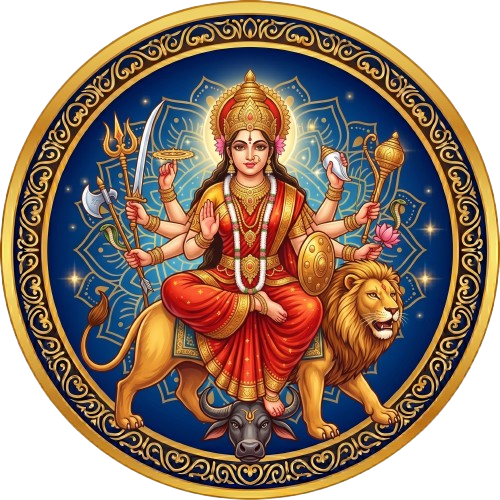
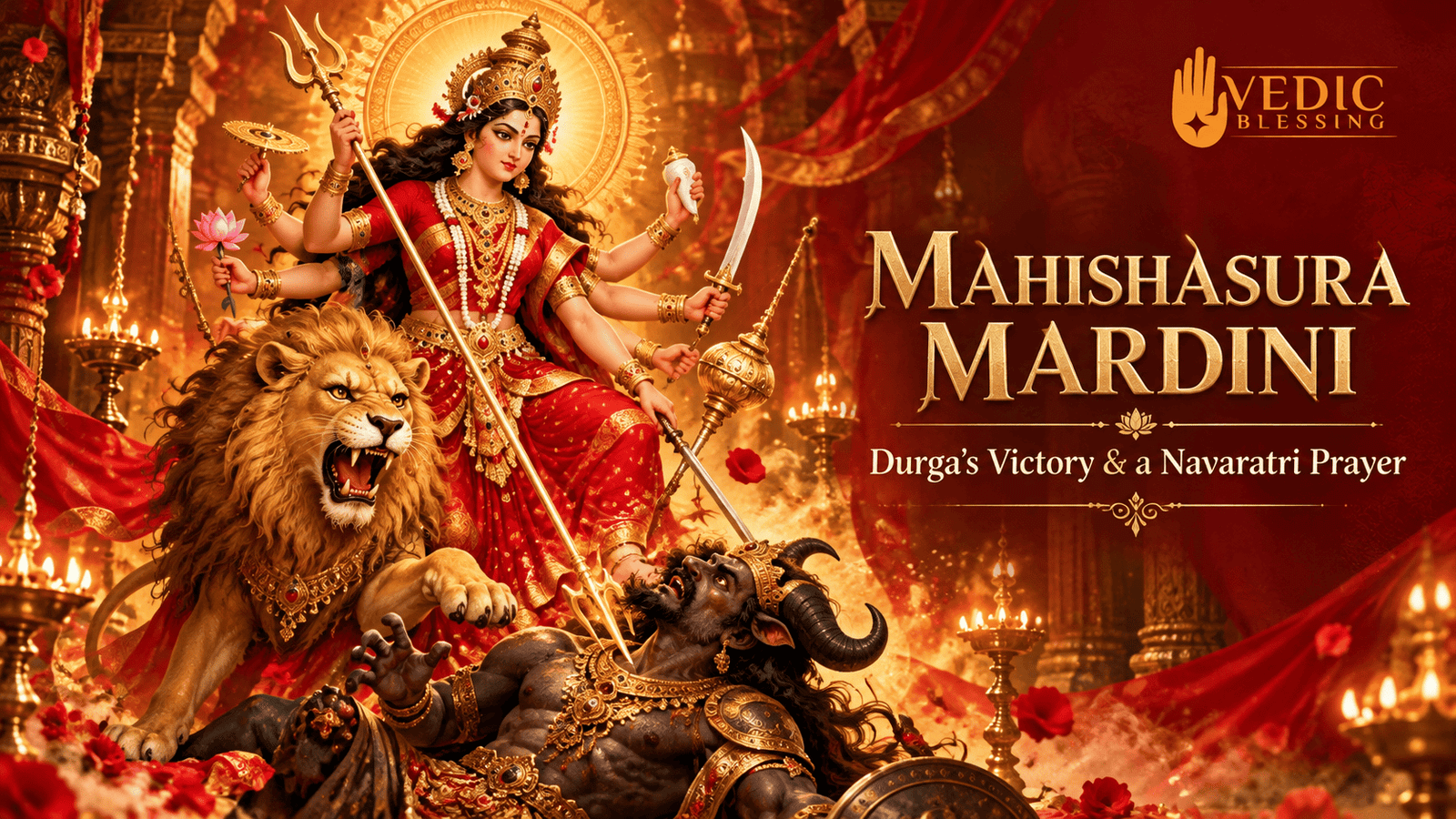
During Navaratri, we see Goddess Durga adorned with flowers, seated on a lion, and holding weapons in her many hands. Many of us grew up seeing this image, lighting a lamp before her, and hearing that she defeated Mahishasura.
But why did the Goddess appear? Why did the devas give her their weapons? What did they say after her victory? And how does the familiar prayer “Sarva Mangala Mangalye” fit into the Devi Mahatmyam?
Understanding the story can make our Navaratri prayers more meaningful. The account of Durga and Mahishasura appears in the Devi Mahatmyam, also known as the Durga Saptashati, within the Markandeya Purana. (devimahatmyam.aurobharati.in)
Who was Mahishasura?
Mahishasura was a powerful asura who defeated the devas and took control of their domains. Driven from their places, the devas went to Brahma, Vishnu, and Shiva and described what had happened. They needed help to overcome a force they could not defeat on their own. (www.wisdomlib.org)
It is easy to picture their distress. The devas had fought, lost, and seen Mahishasura take what they had protected. At that moment, their hope came from seeking help together.
How did Goddess Durga appear?
As the devas spoke of Mahishasura, a great radiance arose from Vishnu, Shiva, Brahma, and the other devas. Their energies came together and took the form of the Goddess.
The devas then offered her their weapons and gifts. Shiva gave her a trident, Vishnu gave her a discus, and others offered weapons of their own. Himavat gave her a lion to ride. Seeing the Goddess before them, the devas rejoiced. (www.wisdomlib.org)
This is a memorable part of the story. The Goddess arises when the divine energies come together, yet she is the one who steps forward to face Mahishasura. The weapons in her hands remind us of that moment and of the purpose for which she received them.
How did Durga defeat Mahishasura?
Durga confronted Mahishasura and his army. The battle was fierce, and Mahishasura kept changing his form. He appeared as a buffalo, a lion, a man, and an elephant before returning to his buffalo form. The Goddess faced each change and finally defeated him. (www.wisdomlib.org)
This victory is why she is called Mahishasura Mardini, the one who vanquished Mahishasura.
When we see Durga on her lion during Navaratri, we are seeing more than a scene from a battle. We are remembering the Goddess who answered the devas’ call and brought an end to Mahishasura’s oppression.
What did the devas do after Durga’s victory?
After Mahishasura and his forces were defeated, the devas bowed and praised the Goddess. Their hymn appears in Chapter 4 of the Devi Mahatmyam. They praised her power and prayed for her protection and blessings. (devimahatmyam.aurobharati.in)
This order is important. First comes the story of her appearance and battle. Then comes the devas’ hymn of gratitude. The text gives us both the courage of the Goddess and the devotion of those she helped.
Why does this story matter during Navaratri?
Navaratri gives us time to remember Goddess Durga and reflect on the strength she represents. Her victory over Mahishasura is remembered as a victory of dharma over a force that caused suffering and disorder.
The story can speak to our everyday lives as well. Challenges do not always stay the same. Mahishasura changes form during the battle; in our own lives, a difficulty may also appear in a new way after we think we have dealt with it. We may face uncertainty at work, worry for our family, or a decision that requires courage.
This is a personal reflection on the story, rather than a fixed meaning assigned to every form Mahishasura takes. Durga’s example invites us to remain steady, seek wisdom, and do what is right even when a challenge feels overwhelming.
Where does “Sarva Mangala Mangalye” come in?
Many devotees know the prayer “Sarva Mangala Mangalye” and associate it with Goddess Durga. It is natural to wonder whether this was the verse the devas recited immediately after she defeated Mahishasura.
The devas did praise her after that victory, but “Sarva Mangala Mangalye” appears later in the Devi Mahatmyam. It is part of the Narayani Stuti in Chapter 11, following the Goddess’s victory over Shumbha and Nishumbha. Both passages praise the Divine Mother, but they occur at different points in the text. (devimahatmyam.aurobharati.in)
That makes the prayer no less meaningful for Navaratri. It gives us another way to turn toward the Goddess after hearing of her strength and compassion.
The “Sarva Mangala Mangalye” prayer and its meaning
सर्वमङ्गलमाङ्गल्ये शिवे सर्वार्थसाधिके।
शरण्ये त्र्यम्बके गौरि नारायणि नमोऽस्तु ते॥
Sarva mangala mangalye, shive sarvartha sadhike,
Sharanye tryambake gauri, Narayani namostute.
A simple meaning is:
“O Goddess, you are the most auspicious among all that is auspicious. You are benevolent and bring about good. You are a refuge to those who seek you. O three-eyed Gauri, Narayani, I bow to you.”
The verse addresses the Goddess with reverence and asks us to remember her as a source of auspiciousness and refuge. It appears as verse 10 of Chapter 11 in the Devi Mahatmyam. (devimahatmyam.aurobharati.in)
Why do devotees recite this prayer during Navaratri?
The prayer is short enough to learn, yet rich in meaning. It does not simply ask for something. It begins by recognizing who the Goddess is to the devotee and ends with an expression of respect: “Narayani namostute,” “O Narayani, I bow to you.”
During Navaratri, reciting it can become a quiet moment of devotion amid the busyness of daily life. We may pray for our family’s well-being, for clarity in a difficult time, or for the strength to act with patience and kindness.
A prayer is not a guarantee that every problem will disappear. Its value also lies in the attention, humility, and faith we bring to it.
How can you include the prayer in your daily Navaratri worship?
Follow your family’s custom if you have one. If you are looking for a simple way to begin, make your prayer space clean and peaceful, light a lamp safely, and offer flowers to Goddess Durga. Recite “Sarva Mangala Mangalye” slowly, then spend a moment thinking about its meaning.
If you are learning the Sanskrit, listen to a careful recitation and practise one phrase at a time. You can read the meaning before you begin so that the words feel personal when you say them.
You can also share the Mahishasura story with children. Tell them why the devas sought the Goddess’s help and ask what courage means to them. It may mean telling the truth, helping someone, or trying again after something difficult. When children understand the story behind a festival, they can carry its meaning forward.
What can we remember when we see Mahishasura Mardini?
Her lion, weapons, and victory are powerful images. Yet the story also asks us to remember why she fought. The devas sought help because Mahishasura had caused suffering. The Goddess answered that need, faced him, and restored hope.
The next time you stand before Durga during Navaratri, pause for a moment. Remember the story of her courage. Remember the devas’ gratitude after her victory. Then, if it is part of your practice, offer the prayer “Sarva Mangala Mangalye” with understanding.
The story gives us something to reflect on. The prayer gives us words to express our devotion.
Frequently asked questions
What does Mahishasura Mardini mean?
Mahishasura Mardini is a name for Goddess Durga that refers to her victory over Mahishasura.
Where is the story of Durga and Mahishasura found?
It is told in the Devi Mahatmyam, also known as the Durga Saptashati, within the Markandeya Purana. (devimahatmyam.aurobharati.in)
Did the devas praise Durga after she defeated Mahishasura?
Yes. Their hymn of praise appears in Chapter 4 of the Devi Mahatmyam, after the account of her victory. (www.wisdomlib.org)
Was “Sarva Mangala Mangalye” the prayer recited immediately after Mahishasura’s defeat?
No. That verse appears later, in the Narayani Stuti in Chapter 11. The hymn following Mahishasura’s defeat is in Chapter 4. (devimahatmyam.aurobharati.in)
Can I recite “Sarva Mangala Mangalye” at home?
Yes. You may include it in your personal prayer during Navaratri, according to your family tradition. Reading its meaning and reciting it attentively can make the prayer more meaningful.
Do I need an elaborate puja to observe Navaratri?
Families observe Navaratri in different ways. A simple prayer at home can be meaningful. If you would like to arrange a formal Durga Puja, an experienced priest can guide you through it.
Celebrate Navaratri with VedicBlessing
Knowing Durga’s story helps us understand the image we worship. Knowing the meaning of “Sarva Mangala Mangalye” helps us pray with greater attention. This Navaratri, share the story with your family, recite a prayer you understand, and make time to remember the Divine Mother.
If you would like to arrange a Navaratri Durga Puja conducted by an experienced priest, VedicBlessing can help you participate online with your family. Share your preferred date and time with your time zone, along with the names to include in the sankalpa, and we will guide you through the arrangements.
Explore the service: https://www.vedicblessing.com/service/navarathri-durga-puja