Varalakshmi Vratham Kalasam Setup: Step-by-Step Guide
Every year the same thing happens the night before Varalakshmi Vratham. The saree is ready, the flowers are bought, the sweets are made—and then somebody asks whether the coconut tuft faces up or sideways and whether the mango leaves go glossy-side in or out. The kalasam is the one part of this vratham that nobody writes down, because it was always learned by standing next to an amma or a paatti.
This guide writes it down. Below is the complete kalasam setup for Varalakshmi Vratham 2026—what to gather, the order of assembly, how to drape and adorn the Amman, the regional differences between Tamil Nadu, Karnataka, and Andhra/Telangana, and what to do with the kalasam after the puja. Varalakshmi Vratham 2026 falls on Friday, 21 August (the last Friday before Shravana Purnima, which is on Saturday, 29 August).
Doing this for the first time? Our Vedic priests guide first-time families through the entire kalasam setup live on video call, in Tamil, Telugu, Kannada or English — including the sankalpam with your gothram and nakshatram. Book a guided Varalakshmi Vratham puja →
What the Kalasam Actually Represents
The kalasam is not a decoration. It is the vigraham—the seat the Goddess is invited into for the day.
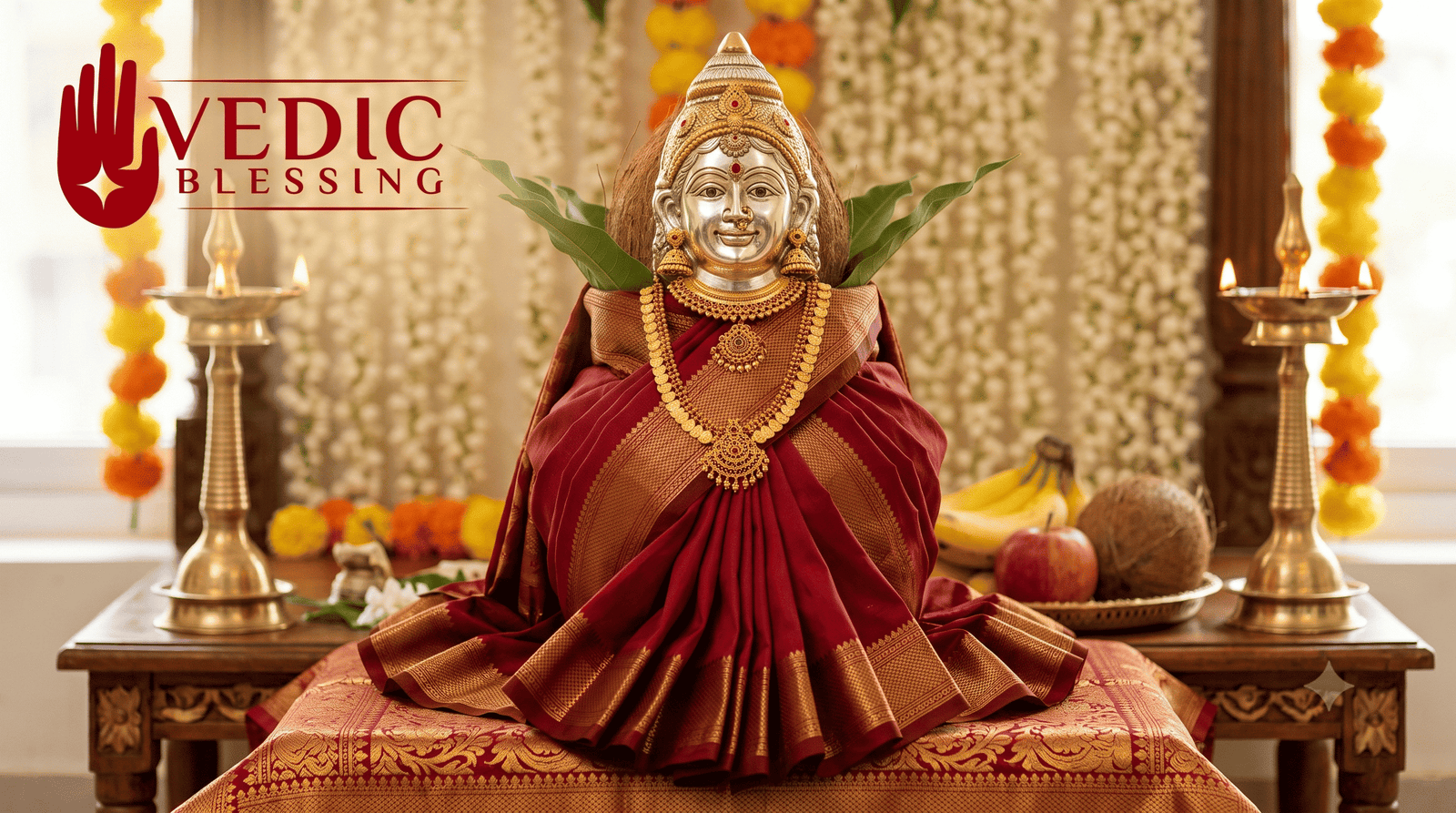
The water or rice inside is the ocean of milk from which Lakshmi emerged. The mango leaves are the five elements. The coconut is the head, the vessel is the body, and the saree and jewellery make her a guest in your home rather than an object on a table. This is why the setup order matters: you are building a form, from the ground upward, and the puja begins only once she is fully seated.
Understanding this makes every rule below make sense. The vessel is never placed directly on the bare floor because you would not seat a guest that way. The coconut tuft points upward because it is the crown. Nothing here is arbitrary.
Complete Kalasam Samagri Checklist
Gather everything the previous evening. Hunting for a missing betel nut at 6 a.m. is how the morning goes wrong.
For the kalasam itself
- Kalasam vessel — silver, brass or copper, with no crack or chip (avoid steel and aluminium)
- Raw rice — about 1 kg for the base, plus a handful for inside the vessel
- Water for filling (or rice, depending on your family custom)
- Whole turmeric root, 1–2 pieces
- One coin (a rupee coin, or a coin of your country of residence)
- Betel nut (pakku / vakka), 2 pieces
- A small gold item — a ring, an earring, or a thin chain
- Mango leaves — 5, 9 or 11, fresh and unbroken
- One coconut with the tuft intact, smeared with turmeric
- Lakshmi face (amman mugam / mukhavarna) — silver, brass or panchaloha
- Cotton thread or a thin gold thread to tie the face
- Sandalwood paste and kumkum
For dressing and decoration
- A new or freshly washed silk saree (a half-saree or a one-metre cut piece works equally well)
- Jewellery — necklace, nose ring, bangles, hair ornament
- Fresh flower garland, plus loose flowers
- A wooden plank (manai / palagai / peeta)
- A bronze or silver plate for the base
- Rice flour or kolam powder
- Two lamps, ghee, cotton wicks
For the vratham
- Nombu saradu / kaappu — nine strands of yellow thread with nine knots, smeared in turmeric
- Mango-leaf thoranam for the main door
- Naivedyam items (see our full naivedyam and prasadam guide)
Varalakshmi Vratham Kalasam Setup: 10 Steps
Do the setup on the morning of the vratham, after bathing, facing east or north-east. Some families set it up on Thursday evening and do only the adornment on Friday morning — both are accepted.
Step 1 — Prepare the place
Clean the puja area thoroughly and draw a kolam on the floor where the plank will sit. Place the wooden plank down and draw a small kolam on the plank itself, then a swastika or a lotus at its centre with rice flour.
Step 2 — Spread the rice base
Place the bronze plate on the plank and spread raw rice evenly across it, about an inch deep. This is Dhanya Lakshmi — the grain that supports the household. Never place the vessel on an empty plate.
Step 3 — Set and fill the vessel
Wash the kalasam vessel, smear turmeric on the outside, and draw three horizontal kumkum lines or a swastika on the front. Place it on the rice.
Fill it with water, then add the turmeric root, the coin, the betel nut, a small gold item and a few grains of raw rice. If your family fills the kalasam with rice instead of water, do that — both traditions are correct, and Tamil families more often use rice while Telugu families more often use water.
Step 4 — Arrange the mango leaves
Insert the mango leaves around the rim so the stems sit inside the water and the leaf tips fan outward and slightly upward, glossy side facing out. Use an odd number — five, nine or eleven. The leaves should form an even collar with no gaps at the front.
Step 5 — Place the coconut
Smear the coconut generously with turmeric and set it on the mango leaves with the tuft pointing straight up. Press it down gently so it sits stable. If it wobbles, add one more mango leaf rather than forcing it.
Step 6 — Fix the amman face
Hold the silver or brass Lakshmi face against the front of the vessel, just below the coconut, and secure it with cotton thread wound around the vessel and tied at the back. The face should sit level and centred.
If you don't have a metal face — which is common for families abroad — a printed and laminated Lakshmi picture propped against the vessel is fully acceptable. Devotion is the requirement; the metal is not.
Step 7 — Drape the saree
Pleat the saree lengthwise and wrap it around the vessel from the back, bringing both ends forward and tucking them so the pleats fan out over the rice base. The face and the coconut stay visible. Let the pallu fall to one side over the shoulder line of the vessel, as it would on a person.
Step 8 — Adorn the Goddess
Place the necklace around the neck of the vessel, the nose ring on the face, bangles at the base, and a hair ornament above the face. Apply sandalwood paste and kumkum to the face. Drape the flower garland last.
Step 9 — Surround with light and flowers
Place the two lamps to the right and left, slightly in front. Scatter loose flowers on the rice base. Arrange fruits, betel leaves and the naivedyam plates in front, not touching the plank.
Step 10 — Place the kaappu and hang the thoranam
Set the nombu saradu at the feet of the kalasam so it is sanctified during the puja — it is tied on the wrist afterwards. Hang the mango-leaf thoranam across the main door and, if you have one, across the puja room entrance.
The kalasam is now ready. From here you move into the puja itself — sankalpam, avahanam, and the sixteen offerings. Our Shodashopachara puja guide walks through all sixteen in order, and the slokas and mantras post gives you every chant with its English meaning.
Regional Variations You Should Know
The setup differs by region, and none of these versions is more correct than another. Follow your family's practice.
Tamil Nadu (Varalakshmi Nombu)
The vessel is usually filled with raw rice rather than water. The face tends to be smaller, and many families use a coconut alone without a metal face. The nombu saradu with nine knots is central and is tied by all the women of the house.
Karnataka (Varamahalakshmi Habba)
The most elaborate of the three. The face is often a large decorative mukhavarna covering the whole front of the vessel, and the saree draping is done properly with pleats, sometimes over a cardboard cone frame to give the Goddess a body. Elaborate flower decoration around the mandapam is common.
Andhra Pradesh and Telangana (Varalakshmi Vratam)
The kalasam is typically water-filled and placed on a rice heap rather than a plate. Turmeric Gauri may be placed alongside. The kalasam is often kept for the full day and immersed the same night.
Common Mistakes to Avoid
- A chipped or cracked vessel. Even a small chip disqualifies the kalasam. Check the rim before the morning.
- Coconut tuft facing sideways or downward. It should point up.
- An even number of mango leaves. Always odd — five, nine, eleven.
- Placing the vessel directly on the floor or on an empty plate. The rice base is not optional.
- Facing south. Set the kalasam facing east or north-east, with you seated facing east or north.
- Broken or torn mango leaves. Buy extra; leaves tear when you insert them.
- Dismantling casually after the puja. There is a proper udvasana — see below.
What to Do With the Kalasam After the Puja
The kalasam is not simply cleared away. Perform the udvasana prarthana, asking the Goddess to depart, and then:
- The water is sprinkled around the house and on family members.
- The rice from the base and inside the vessel is cooked and eaten as prasadam. Many families mix it into the next day's rice.
- The coconut is broken and used for prasadam or in the next day's cooking.
- The turmeric root and the coin are kept in the cash box or the almirah through the year.
- The mango leaves and flowers are placed in flowing water or under a tree, never in the household bin.
Some families dismantle it the same night; others keep the kalasam until Sunday, or until the following Purnima. Both are customary — follow what your family has always done.
Frequently Asked Questions
What time should I set up the kalasam for Varalakshmi Vratham 2026?
Set it up on the morning of Friday, 21 August 2026, after bathing and before the puja. The Simha lagna morning window and the evening Pradosha kaal window (roughly 7–9 p.m.) are both considered highly auspicious for the puja itself. Confirm exact muhurtham for your city, as it shifts with local sunrise.
Can I use a steel vessel for the kalasam?
Traditionally no. Silver, brass or copper are used. If you have no alternative, a clean steel vessel with sincere devotion is better than skipping the vratham — but replace it in future years if you can.
Should the kalasam be filled with water or rice?
Both are correct. Tamil families more commonly use raw rice; Telugu and Kannada families more commonly use water. Follow your family's custom, and if there isn't one, water is the more widespread practice.
How many mango leaves should I use?
An odd number — five, nine or eleven. Nine is the most common choice. Glossy side facing outward, tips angled up.
What if I can't find mango leaves where I live?
Betel leaves or areca leaves are accepted substitutes, and many families abroad use good-quality artificial mango leaves reserved only for puja use. The intention carries the ritual.
Which direction should the kalasam face?
East or north-east. You should sit facing east or north while performing the puja. Avoid facing south.
Can unmarried women or men set up the kalasam?
Yes. The vratham is traditionally observed by married women, but unmarried women, widows and men can all perform it. Lakshmi's blessings are not restricted.
Do I need to know my gothram to perform the vratham?
It helps for the sankalpam, but it is not mandatory. If you don't know your gothram, "Kashyapa gothram" is used as the default, and our priests can guide you through this on the call.
Can I set up the kalasam the previous evening?
Yes. Many families assemble the vessel, leaves and coconut on Thursday evening and complete the saree, jewellery and flowers on Friday morning before the puja.
How long should the kalasam stay in place?
Anywhere from the same night to the following Sunday, depending on family custom. Perform the udvasana prarthana before dismantling it, whenever that is.
If this is your first Varalakshmi Vratham or you're doing it far from family and want someone who knows the tradition beside you, our priests are available all day on 21 August 2026.
Perform Varalakshmi Vratham 2026 with a Vedic priest
Live guided puja on Friday, 21 August 2026 — kalasam setup, sankalpam with your gothram and nakshatram, the sixteen offerings, and udvasana. Available in Tamil, Telugu, Kannada, Hindi and English, with timings for India, USA, UK, Canada, Australia and Singapore.
Book your Varalakshmi Vratham puja , our whats app number - +91 9063082668
Related reading Varalakshmi Vratham 2026: Date, Significance & Puja Guide · Shodashopachara Puja: 16 Sacred Offerings · Slokas and Mantras with Simple Meanings · Naivedyam and Prasadam Guide